

Real Estate Tips
Catch-Up Bookkeeping for Realtors: How to Fix Months of Missing Expenses
Months behind on bookkeeping? Here's a 5-step process to recover receipts, sort your expenses and get your books current without starting from scratch.

Closing a few deals in a strong month can make a real estate business look highly profitable. But commission income alone doesn't show how much an agent actually earned — brokerage deductions, referral fees, marketing costs, MLS dues, vehicle expenses, software subscriptions, staging, and photography all affect the final number. That's where a Profit and Loss statement becomes useful.
A Profit and Loss statement — often shortened to P&L, or called an income statement — summarizes what a business earned, what it spent, and what remained over a specific period. For Realtors dealing with irregular commission income, it usually gives a much clearer view of business performance than sales volume or a bank balance ever could on their own.
At its simplest, a P&L comes down to one equation: Income − Business Expenses = Net Profit or Loss. For a real estate agent, that usually breaks down into four parts — income (commissions, referral income, and other business income), commission deductions (brokerage splits, referral payouts, and other transaction-related deductions, depending on how records are structured), operating expenses (marketing, MLS dues, vehicle costs, software, education, and the rest), and finally net profit or loss — what's left once everything above it has been accounted for.
The point isn't just to produce a number for tax time. A P&L answers a more practical question: is the business actually making money after the cost of running it?
Sales volume can look impressive while actual profitability tells a very different story. Picture two agents closing roughly the same amount of business in a year. One spends heavily on paid advertising, staging, photography, software, and lead generation; the other keeps operating costs much lower. Their sales numbers might look nearly identical — their net profit almost certainly won't.
A P&L separates activity from profitability. It shows how much income was generated, how much it cost to generate it, which expense categories are creeping up, whether income is keeping pace with spending, and how profitability shifts from month to month. For commission-based work, this matters because a large check can create the impression that the business is doing well even when a significant chunk of that money is already spoken for — expenses, taxes, brokerage deductions, or costs still to come.
Income can come from more than one source — commission from closed deals, referral income, consulting or advisory fees, and other real estate-related income. Keeping these sources separated rather than recording every deposit as one general income figure makes the report considerably more useful.
Commission income often needs a bit more context than a single number, since the amount tied to a closed transaction can differ from what actually reaches the agent's bank account after brokerage deductions or other adjustments. Keeping commission records connected to the transaction they came from makes this much easier to track — our Commission Tracking Software for Realtors guide covers that workflow in more detail.
Not every dollar tied to a commission becomes income the agent actually keeps. Depending on the arrangement, deductions might include brokerage splits, team splits, transaction-related fees, or referral fees paid to another party — exactly how these appear on a P&L depends on how the agent and accountant organize the records. The useful point either way: recording only the final bank deposit hides part of the picture. Keeping the commission, the deductions, and the net payment clearly documented makes it much easier to understand what a transaction actually contributed to the business.
Operating expenses are the day-to-day cost of running the business — marketing and advertising, MLS and association dues, vehicle expenses, technology and software, education and training, office rent and supplies, phone and internet, professional fees, home office costs, client-related expenses, and bank or interest charges. Some of these are predictable every month; others swing depending on how active the agent is.
A P&L becomes especially useful when these categories are tracked over time. A single software subscription rarely looks significant on its own, but several recurring costs stacked alongside marketing and vehicle expenses can have a real effect on profitability. Our Expense Tracking Software for Realtors guide goes deeper into organizing these costs.
Once income and relevant expenses are recorded, what's left is the business's profit or loss for that period:
Example | Amount |
|---|---|
Commission and other income | $25,000 |
Brokerage and transaction-related deductions | $5,000 |
Operating expenses | $8,000 |
Net profit before personal taxes | $12,000 |
That $12,000 doesn't necessarily mean the agent has $12,000 sitting around to spend personally — taxes, personal obligations, upcoming business expenses, and cash timing are separate considerations entirely. Which raises an important distinction: profit and cash are not the same thing.
A business can show a healthy profit on paper while still running into a cash shortage. An agent might have earned strong commissions earlier in the quarter — those contribute to profitability — but the cash from them may already be gone, spent on operating expenses, tax reserves, or personal draws, while future expenses keep arriving even though the next closing is delayed.
A P&L answers one question: did the business earn more than it spent during this period? Cash flow answers a different one: does the business have enough available cash right now to cover what's coming? Both matter, and reviewing a P&L alongside actual cash activity tends to give a far more complete view than either one alone.
When income and expenses get recorded also affects what shows up on a P&L. Under a cash basis, income and expenses are generally recorded when money actually changes hands — for a Realtor, that typically means recording commission when it's received rather than treating a pending deal as completed income, which tends to keep the records aligned with actual bank activity. Under an accrual basis, income and expenses are recorded when they're earned or incurred, even if the money moves later.
Which method fits depends on business structure, reporting requirements, and professional advice. The practical takeaway either way is simple: expected commissions and received commissions shouldn't get confused with each other. A pending deal is useful for forecasting — it shouldn't be treated as cash already available.
A P&L is far more useful reviewed for patterns than checked only for the final profit number. A few questions worth asking every month:
Is income consistent? Real estate income is rarely perfectly steady, but looking at several months together tends to reveal patterns — seasonal slowdowns, months with multiple closings, heavy dependence on one or two large transactions, or periods where expenses continue with no new commission coming in. The goal isn't for every month to look identical; it's understanding how the business actually behaves.
Which expenses are growing? Marketing might climb because the business is genuinely growing, which can be perfectly reasonable — but recurring costs also grow quietly through extra subscriptions and small commitments that add up without anyone noticing in the moment. A P&L makes those shifts easier to catch.
Are deal costs affecting profitability? Some expenses are general business costs; others are tied to a specific transaction — photography, staging, signage, or advertising connected to one particular listing. When those costs stay linked to the deal that produced the commission, it's much easier to see what it actually cost to generate that income, which is part of why deal tracking software for Realtors adds useful context here.
Is net profit actually improving? Rising income doesn't automatically mean rising profit. If revenue grows 20% while expenses grow 30%, the business may be getting less profitable even as the top-line number looks better. Income and expenses need to be read together, not watched separately.
Consider a Realtor reviewing one month of activity. Income for the month totals $20,500 — $18,000 in closed-deal commissions, $2,000 in referral income, and $500 in other business income. Expenses total $6,000 — $2,500 in marketing and advertising, $600 in MLS and association dues, $800 in vehicle expenses, $450 in software and technology, $300 in education and training, and $1,350 in other business expenses.
Net profit for the month: $20,500 − $6,000 = $14,500. That's a profitable month on paper — the real question is what explains it. Was there an unusually large transaction? Did marketing costs shift? Is this income repeatable next month, and are there recurring expenses that'll continue even if the next commission is delayed? That's exactly where reviewing several months together tends to be far more useful than looking at any single one in isolation.
A single month is useful for catching patterns early, but a full-year P&L makes the bigger picture easier to see — especially how much of gross commission income actually survives all the way down to net profit.
Take a simulated example: an agent with $150,000 in gross commission income for the year. Brokerage splits and transaction or franchise fees take $35,000 off the top (roughly 23% of GCI), leaving net adjusted revenue of $115,000. From there, marketing and lead generation account for $12,000 (about 8% of GCI), and the rest of operating expenses — vehicle costs, software and professional fees, office supplies, continuing education, and insurance — add up to another $18,000 (about 12%). What's left is $85,000 in net profit before personal taxes, or a little under 57% of the original GCI.
Category | Amount | % of GCI |
|---|---|---|
Gross Commission Income | $150,000 | 100% |
Brokerage splits & fees | −$35,000 | 23.3% |
Marketing & lead generation | −$12,000 | 8.0% |
All other operating expenses | −$18,000 | 12.0% |
Net profit (before personal taxes) | $85,000 | 56.7% |
deal tracking software for Realtors
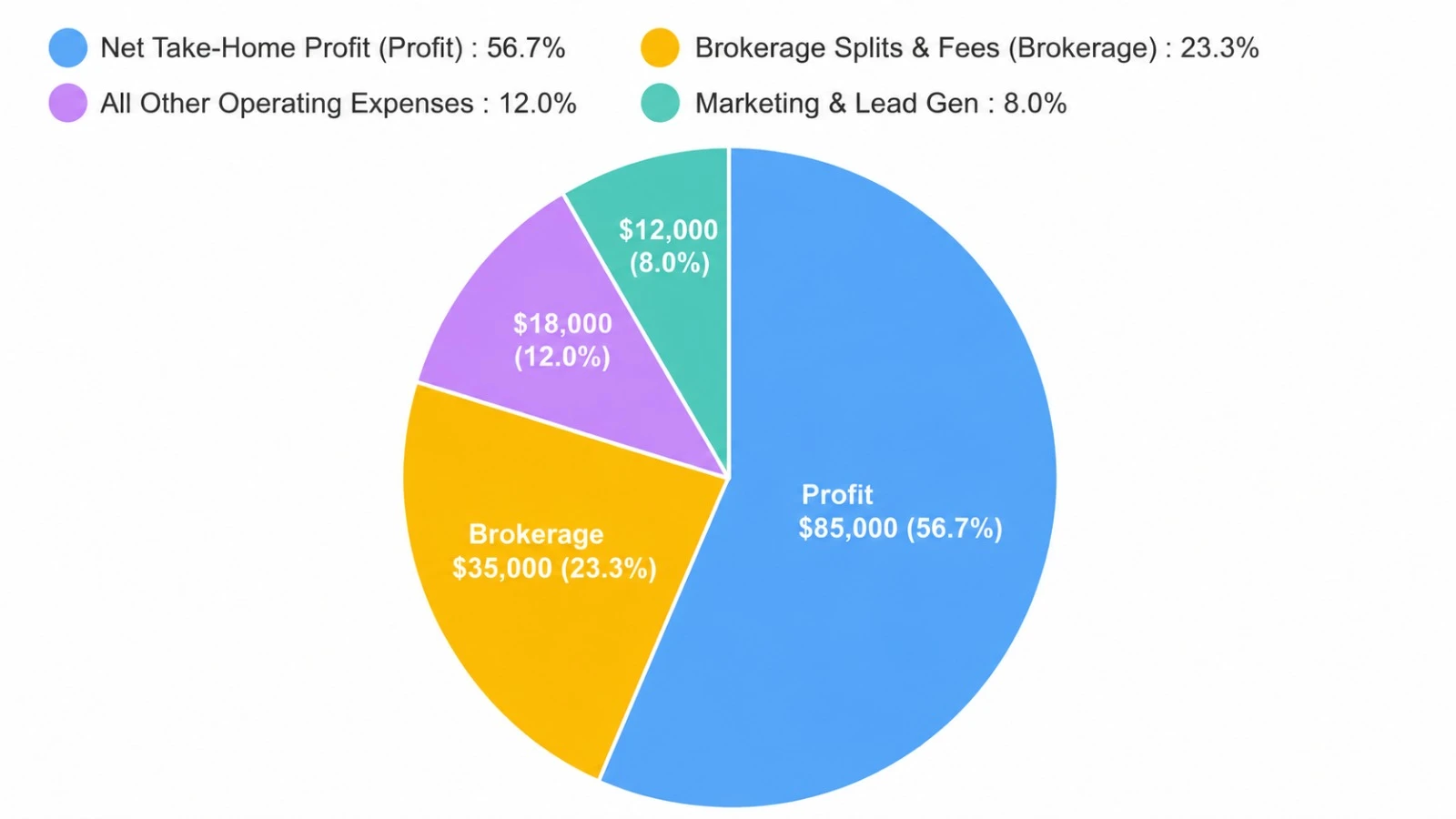
Seen this way, the gap between GCI and take-home profit is a lot more visible than it is buried in a single line item. It's also a useful gut check on a couple of common benchmarks: many advisors suggest setting aside roughly a quarter to a third of net profit for self-employment and income taxes before treating any of it as spendable, and keeping marketing spend somewhere under 10% of GCI is a reasonable rough guideline — though the right number depends heavily on the agent's market, lead sources, and business model, so it's more of a health check than a hard rule.
A P&L is only as reliable as the records behind it, and a few habits tend to make the final report misleading. Recording only net deposits hides the full commission structure — if brokerage deductions and other adjustments aren't recorded clearly, the actual financial activity behind a deal gets harder to reconstruct later. Mixing personal and business spending — groceries, personal bills, commissions, and business purchases all running through the same records — makes producing a meaningful P&L much harder than it needs to be. Treating every deposit as income overlooks the fact that a deposit could be a reimbursement, a transfer, or something else entirely rather than actual business income. Waiting until tax season to reconstruct a year's worth of records is difficult by nature — receipts go missing, details get forgotten, and duplicates become harder to spot. Ignoring small recurring costs lets a handful of $20–$50 monthly charges quietly become a meaningful annual expense. And confusing profit with available cash overlooks that a profitable month doesn't guarantee the same amount is sitting there to spend — some of it may already be earmarked for taxes, upcoming bills, or reserves.
Monthly is a practical starting point for most agents — it surfaces missing transactions, spending shifts, income trends, and creeping recurring costs while the details are still fresh. A receipt from last week is a lot easier to track down than one from ten months ago. Quarterly reviews add a broader view on top of that, and an annual report ties the full year together for both business review and tax preparation.
A P&L organizes the income and expense information an accountant or tax professional needs, but it doesn't decide what's deductible or calculate tax obligations on its own. Tax treatment depends on business structure, location, the purpose and use of an expense, and applicable federal, state, provincial, or GST/HST requirements where relevant — which is why a P&L is best treated as an organized financial record, with tax filing and specific deductions confirmed by a qualified tax professional. Marketing, MLS dues, vehicle costs, education, technology, and home office expenses are all common business categories, but exactly how any one of them is treated for tax purposes still comes down to individual circumstances.
A useful P&L depends on organized income and expense records, and AgentXpense brings that information into one workspace. Commission income from closed deals stays connected to the transaction it came from, while referral and other income are recorded separately. Expenses can be organized into real estate-focused categories, linked to deals where relevant, and supported with attached receipts — with AI receipt scanning, category suggestions based on past records, and duplicate detection handling much of the repetitive work. CSV, Excel, and PDF imports go through Transaction Review before becoming part of the ledger, and income and expense reports can be pulled for any selected period, exported to CSV, or printed directly.
None of this replaces an accountant or makes financial decisions on its own — the goal is simply keeping the records behind the numbers organized throughout the year, so that when income, commissions, expenses, deals, and receipts are already recorded in one place, reviewing business performance takes a lot less reconstruction.
A Profit and Loss statement gives a Realtor something sales volume and a bank balance can't provide on their own: a clear picture of what the business actually earned after the cost of running it. The most useful P&L comes from records maintained throughout the year — income identified correctly, expenses categorized consistently, commission deductions kept visible instead of disappearing into a single net deposit, and recurring costs reviewed before they quietly grow.
The goal isn't just producing a report at tax time. A regularly reviewed P&L shows how the business is actually performing, where the money is going, which costs are climbing, and whether higher income is really producing higher profit — or just moving more money through the account.
A Profit and Loss statement summarizes a Realtor's business income and expenses over a specific period — a month, a quarter, or a year — to show whether the business made a profit after its operating costs.
A Realtor's P&L typically includes commission income, referral income, other business income, brokerage or transaction-related deductions, and operating expenses such as marketing, MLS dues, vehicle costs, technology, education, and professional fees.
Monthly is a practical routine for most agents, since it surfaces missing transactions, spending changes, and income patterns while the details are still recent. Quarterly and annual reviews then provide a broader view.
Gross commission is the commission amount before relevant deductions and business expenses. Net profit is what remains after deducting the business costs recorded.
No. A business can be profitable during a period while having limited cash on hand, since money may already be spent, reserved for taxes, committed to upcoming expenses, or used for other obligations.
A pending commission and money already received are different things. Pending deals are useful for forecasting, but whether they should be recognized in financial records depends on the accounting method used and the agent's individual circumstances.
Yes. A spreadsheet can organize income and expenses and calculate profit, though a manual system requires maintaining formulas, categories, receipts, and transaction records consistently throughout the year.
AgentXpense organizes commission income, other income, expenses, deals, receipts, and reports in one workspace, which can be reviewed by period to understand the income and expense information behind business performance.
No. A P&L focuses on income, expenses, and profit or loss during a specific period. A balance sheet focuses on assets, liabilities, and equity at a specific point in time.
Months behind on bookkeeping? Here's a 5-step process to recover receipts, sort your expenses and get your books current without starting from scratch.
Should Realtors keep their books by hand, hire a bookkeeper or use AI? Compare the options on cost, time and accuracy before you decide.

Stop spending your 11 p.m. evenings sorting faded receipts. Learn exactly what AI bookkeeping can automate for real estate agents, where your human review still matters, and how Agent Xpense saves you hours of manual work.
2255 Dundas Street West, Suite 207 Mississauga, ON L5K 1R6
© Agent Xpense Inc. All rights reserved.