

Real Estate Tips
Catch-Up Bookkeeping for Realtors: How to Fix Months of Missing Expenses
Months behind on bookkeeping? Here's a 5-step process to recover receipts, sort your expenses and get your books current without starting from scratch.
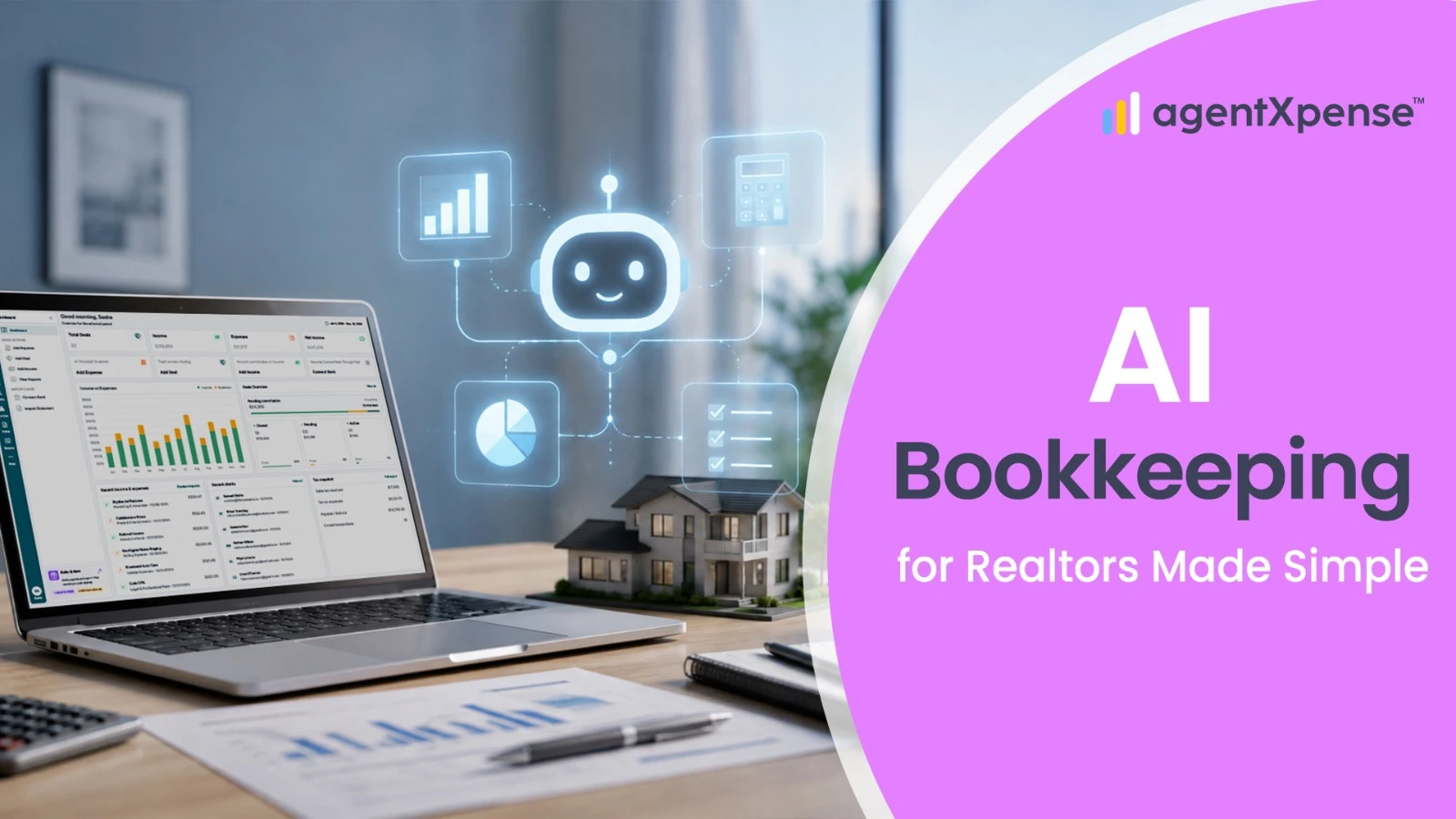
Real estate income doesn't behave like a paycheck. A Realtor might close nothing for six weeks and then close three deals in one month, with commission checks, referral fees, brokerage deductions, and a long list of expenses — marketing, staging, MLS dues, vehicle costs — all moving at their own pace. Bookkeeping is what keeps that irregular flow of money organized enough to actually understand, and increasingly, agents are looking for the best AI bookkeeping software for realtors rather than a spreadsheet that needs constant manual upkeep.
This guide covers what bookkeeping software for realtors and real estate agents actually needs to do, why real estate bookkeeping works differently than bookkeeping for a typical small business, and what separates manual tracking from AI-powered bookkeeping for real estate agents before looking at how AgentXpense fits into that picture.
Bookkeeping is the ongoing process of recording every financial transaction a business generates — money coming in and money going out — so that at any point, the business owner can answer basic questions: What did I earn? What did I spend? What's left over? What do I owe in taxes?
For a real estate agent, that record typically includes:
Income — commission from closed deals, referral fees, and other business income
Expenses — marketing, MLS and association dues, vehicle costs, technology, education, and more
Receipts — the supporting documentation behind both income and expenses
Reconciliation — making sure recorded transactions match bank and brokerage statements
Reports — a periodic summary (monthly, quarterly, or annual) of income, expenses, and net profit
Bookkeeping isn't the same as accounting or tax preparation. Bookkeeping is the record-keeping layer — accurate, organized, up to date. Accounting and tax preparation build on top of that record to make decisions and file returns. Good bookkeeping makes both of those easier; it doesn't replace them.
Most small businesses have relatively predictable income — a retail shop rings up sales daily, a service business invoices clients on a schedule. Real estate income is "lumpy": long stretches with little or nothing, followed by a month with two or three closings at once. That volatility changes how bookkeeping needs to work.
A few things make real estate bookkeeping distinct from generic small-business bookkeeping:
Commission isn't a simple invoice. A closed deal generates a gross commission, a brokerage deduction, and a net amount actually paid out. Recording only the net deposit — what actually lands in the bank — creates a mismatch with what a brokerage reports at year-end, which is usually the gross figure. This is often where commission tracking software for realtors becomes useful — keeping the gross, the deduction, and the net tied to the same record instead of reconstructed separately.
Expenses are spread across many small categories. Marketing, signage, staging, photography, MLS dues, continuing education, vehicle costs, and client gifts don't fit neatly into a generic "supplies" or "services" category the way they might for other businesses.
Most agents are self-employed. In the US, that typically means operating as a sole proprietor or through a business entity and being responsible for self-employment tax and quarterly estimated payments. In Canada, it often means managing GST/HST registration and remittance in addition to income tax. Bookkeeping built for real estate needs to account for this rather than assuming a simple W-2/T4 employee structure.
Deals generate both income and expenses at once. A single transaction might produce a commission and, at the same time, a set of marketing and staging costs tied specifically to that property. Bookkeeping that treats income and expenses as entirely separate loses that connection — which is the core idea behind deal tracking software for realtors: keeping both sides of a transaction linked together.
A complete bookkeeping setup for a real estate agent typically covers five areas:
Every source of income — commission, referrals, other fees — recorded as it arrives, ideally categorized by type rather than lumped into one running total. Gross commission and brokerage deductions are worth tracking separately from the net amount, since brokerages generally report the gross figure at year-end. A dedicated income tracking software for realtors approach usually makes this easier than a single blended spreadsheet column.
Every business purchase, categorized consistently. Real estate-specific categories — marketing, MLS dues, vehicle expenses, home office costs, education, technology — make it easier to see where money is actually going and what's likely deductible. This is generally where expense tracking software for realtors earns its keep over a generic spreadsheet template.
Supporting documentation for both income and expenses. A commission statement or referral agreement is just as useful to have on file as an expense receipt, particularly if a brokerage's reported figures ever need to be reconciled against personal records.
Matching recorded transactions against bank statements, brokerage statements, and credit card statements to catch errors, duplicates, or missing entries before they compound.
A periodic summary — income, expenses, net profit, and (where applicable) sales tax collected and paid — reviewed regularly rather than reconstructed once a year under deadline pressure.
For a long time, "bookkeeping" for a Realtor meant a spreadsheet, a folder of receipts, and an hour or two set aside every week (or, more often, skipped every week and caught up on every quarter). That approach works at a small scale but tends to break down as the number of transactions grows.
Manual bookkeeping typically involves:
Typing every transaction in by hand
Matching receipts to entries after the fact
Calculating subtotals and tax manually
Reviewing bank and brokerage statements line by line to catch mismatches
Rebuilding reports from scratch before tax season
AI-powered bookkeeping automates the repetitive parts of that process without removing the agent from the decision:
Receipt scanning reads the vendor, date, and amount from a photo or PDF, rather than requiring manual entry
Category suggestions are based on past vendor history, so the tenth Home Depot receipt doesn't need re-categorizing from scratch
Bank or statement imports use AI column mapping to identify dates, amounts, and descriptions automatically
Duplicate detection flags likely repeat entries before they're saved twice
The distinction matters: AI-powered bookkeeping doesn't remove the need to review entries — it removes the need to type and calculate everything from zero. The agent still confirms what the system suggests; they're just starting from a pre-filled form instead of a blank one.
Not every accounting tool is built with real estate in mind. When comparing options, a few things are worth checking for in the best AI bookkeeping software for realtors:
Real estate-specific expense categories — not a generic chart of accounts that has to be customized from scratch
Commission and deal-linked tracking — the ability to tie income and expenses back to the transaction that generated them
AI receipt scanning — OCR and data extraction that pre-fills entries instead of requiring manual typing
Automatic tax calculation — subtotal, tax, and total calculated from a simple tax-type selection, rather than manual math on every entry
Duplicate detection — a safeguard against double-entering the same transaction from a receipt and a bank import
Import and export options — the ability to bring in existing records (CSV, Excel, PDF) and export data out for an accountant
Reports built for tax time — income, expenses, net income, and sales tax summarized by date range, not reconstructed by hand
A good AI bookkeeping system for Realtors should cover most or all of these areas; a generic small-business accounting tool often requires significant customization to get there.
 Click here
The core bookkeeping process — record income, record expenses, reconcile, report — is the same on both sides of the border. Tax treatment is where things differ.
Area | USA | Canada |
Business income | Commission and related real estate income | Commission and related real estate income |
Self-employment | Sole proprietor or business entity; self-employment tax generally applies | Self-employed or incorporated; CPP contributions generally apply |
Sales tax | Rules vary by state and locality | GST/HST registration and remittance may apply depending on revenue and registration status |
Vehicle expenses | Business-use vehicle costs may be deductible with proper records | Business-use vehicle and kilometer records may be relevant |
Tax filing | Depends on business structure and individual circumstances | Depends on business structure, province, and registration status |
Bookkeeping for US realtors and bookkeeping for Canadian realtors share the same underlying discipline — organized, categorized records — but Canadian agents generally have an added layer: tracking GST/HST collected on commission and GST/HST paid on business expenses, so the two can be reconciled at filing time. Specific tax obligations in either country depend on individual circumstances and should be confirmed with a qualified accountant or tax professional.
A few patterns show up often enough to be worth calling out directly:
Recording only the net deposit. Tracking what hits the bank account instead of the gross commission creates a mismatch with brokerage year-end reporting, which usually shows the gross figure.
Mixing personal and business funds. Paying for marketing or client gifts on a personal card, or depositing commissions into a personal account, makes it far harder to defend legitimate business deductions later.
Treating taxes as a once-a-year event. Waiting until filing season to figure out what's owed, rather than setting aside a portion of each commission as it arrives, often leads to a larger bill and possible penalties for underpayment.
Reconstructing records after the fact. Estimating expenses or mileage at year-end from memory, rather than logging them close to when they happen, tends to produce incomplete and less defensible records.
Lumping all income together. Blending commission, referral fees, and other income into one number makes it hard to see which income sources are actually worth the time they take.
AgentXpense is built specifically around the bookkeeping needs described above, rather than a generic small-business accounting structure. As real estate bookkeeping software for agents, it combines Deals, Commissions, Income, Expenses, Clients, Receipts, and Reports in one workspace, with 13 default expense categories built for real estate, AI receipt scanning that pre-fills vendor, date, and amount, and automatic tax calculation through a simple tax-type field. Commission income created from a closed deal flows directly into Income → Commissions, keeping the gross figure, the brokerage deduction, and the net amount connected to the transaction they came from rather than typed in separately.
For Realtors in the USA and Canada looking to move from a spreadsheet to a more structured, AI-assisted approach, AgentXpense offers a 30-day free trial with no credit card required — a practical way to see whether a purpose-built system fits better than a generic one before making it part of the regular routine.
Bookkeeping for real estate agents is the process of recording all business income (commission, referrals, other fees) and expenses (marketing, MLS dues, vehicle costs, and similar) so the agent has an accurate, organized financial record to review and use for tax preparation.
Many self-employed real estate agents handle their own bookkeeping using dedicated software, especially early on, and bring in a bookkeeper or accountant as transaction volume grows or when preparing for tax filing. Whether a bookkeeper is necessary depends on the complexity of the business and the agent's comfort with financial recordkeeping.
Categorizing expenses by type as they happen — rather than sorting receipts once a year — and keeping the receipt attached to each entry is generally considered best practice. Software with AI receipt scanning and built-in real estate categories can make this significantly faster than a spreadsheet.
AI can automate much of the repetitive work — reading receipts, suggesting categories based on past vendors, mapping bank statement columns — but it doesn't replace the agent's review or an accountant's judgment. It reduces manual data entry rather than removing the need for oversight.
Common categories include marketing and advertising, MLS and association dues, vehicle expenses, home office costs, technology and equipment, and continuing education, though what's actually deductible depends on individual circumstances and should be confirmed with a tax professional.
Many self-employed agents set aside a portion of each commission for taxes as it's received, rather than waiting until filing season, since both income tax and self-employment tax (or CPP contributions in Canada) typically apply. The exact amount depends on income level, business structure, and location.
General accounting software like QuickBooks can track income and expenses, but it isn't built around real estate-specific workflows like commission-to-deal tracking or pre-set realtor expense categories — those typically need to be configured manually. Purpose-built real estate bookkeeping software includes them by default.
Bookkeeping is the day-to-day recording of income and expenses. Accounting uses those records for tax planning, financial analysis, and filing returns. Good bookkeeping throughout the year makes accounting and tax preparation faster and more accurate.
Months behind on bookkeeping? Here's a 5-step process to recover receipts, sort your expenses and get your books current without starting from scratch.
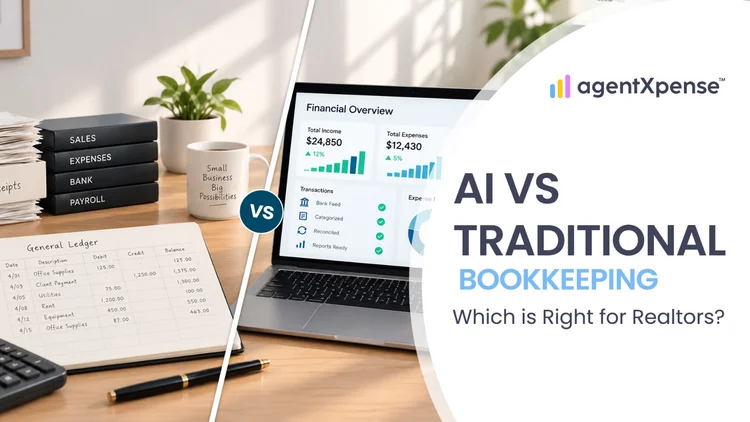
Should Realtors keep their books by hand, hire a bookkeeper or use AI? Compare the options on cost, time and accuracy before you decide.

Stop spending your 11 p.m. evenings sorting faded receipts. Learn exactly what AI bookkeeping can automate for real estate agents, where your human review still matters, and how Agent Xpense saves you hours of manual work.
2255 Dundas Street West, Suite 207 Mississauga, ON L5K 1R6
© Agent Xpense Inc. All rights reserved.