

Real Estate Tips
Catch-Up Bookkeeping for Realtors: How to Fix Months of Missing Expenses
Months behind on bookkeeping? Here's a 5-step process to recover receipts, sort your expenses and get your books current without starting from scratch.
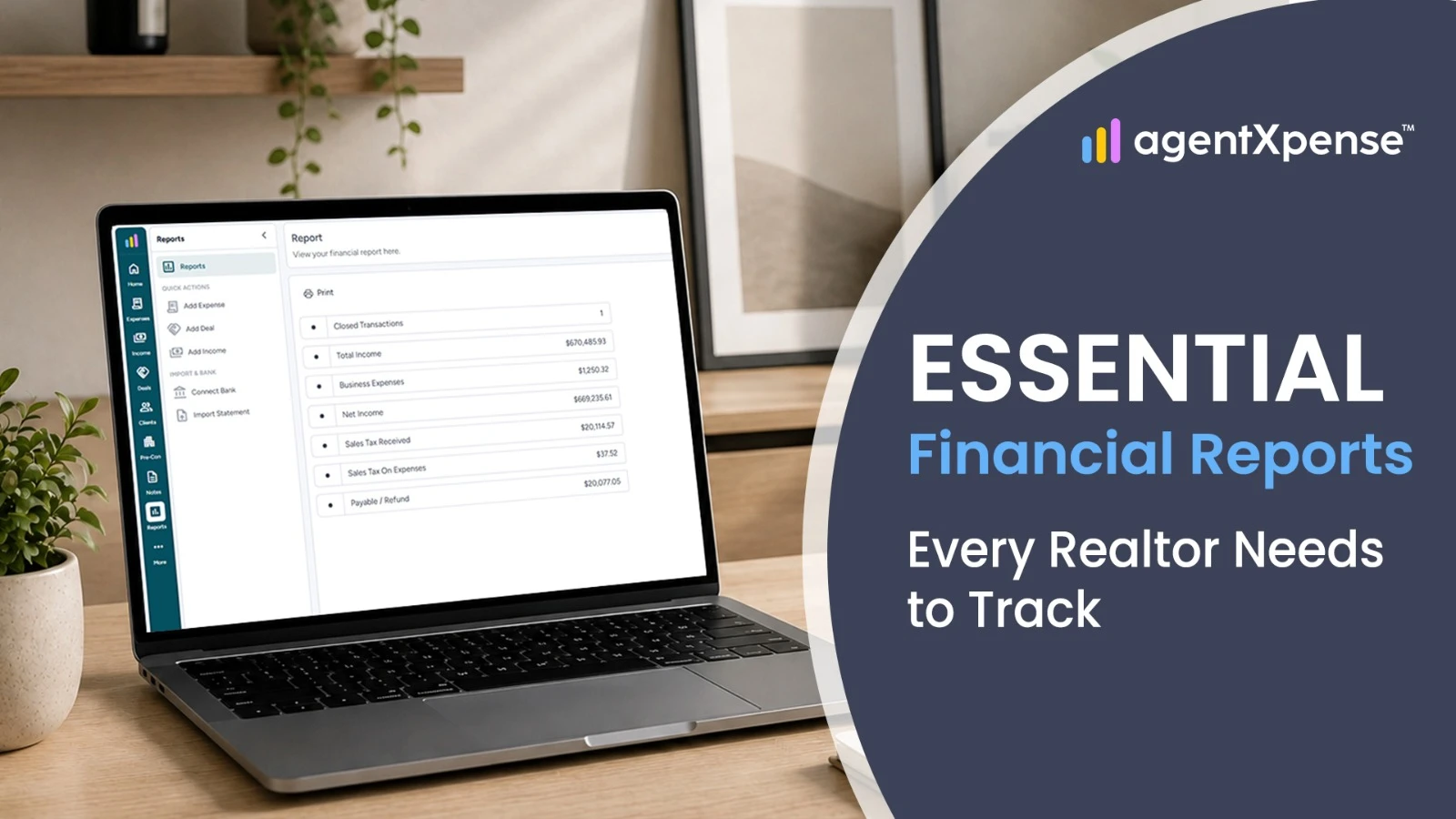
Real estate income rarely follows a predictable schedule. One month can bring several closings, while the next may have little or no commission income. At the same time, marketing, MLS fees, software, vehicle costs, insurance, and other business expenses continue throughout the year. Financial Reports for Realtors give agents a practical way to monitor these changes and understand how they affect the business.
Financial reports give Realtors a practical way to see how those moving pieces affect the business. A Profit and Loss Statement shows profitability, a Cash Flow Report shows the timing of money coming in and going out, and commission and expense reports provide the detail behind those numbers.
The most useful reporting system connects these pieces. A Realtor should be able to see what has been earned, what has been spent, what is still pending, and where the business stands financially without reconstructing the numbers from separate spreadsheets and receipts.
The reports below provide that foundation.
Realtor finances are closely tied to individual transactions. Commission income may depend on closing dates, brokerage splits, referral arrangements, team agreements, and other deductions. Meanwhile, business expenses can occur well before a commission is received.
A useful reporting system therefore needs to connect income with the activity behind it. A closing might generate a strong commission, but the amount the Realtor keeps can change considerably after brokerage deductions and transaction-related costs.
The same applies to expenses. Marketing, MLS and association fees, vehicle costs, technology, professional services, education, and client-related spending can have very different effects on profitability.
This is why reviewing only a bank balance or total annual commissions gives an incomplete picture. The reports need to show both where the money came from and where it went.
Real estate businesses can have financial patterns that are difficult to understand from a bank balance alone. A bank account might show $20,000 today, but that balance does not explain how much came from recently received commissions, how much is needed for upcoming expenses, or how profitable the business has been over time.
Financial reports and statements organize these details into clear information that Realtors can review, compare, and use to understand the financial position of their business.
Revenue is only one part of the financial picture.
A Realtor may generate significant gross commission income but also have brokerage splits, referral fees, marketing costs, MLS and association dues, vehicle expenses, technology subscriptions, insurance, education, and other operating costs.
A Profit and Loss Statement brings these numbers together so the agent can see the amount left after business expenses.
That makes it easier to answer an important question:
How much is the real estate business actually earning after its costs?
Profit and cash are not the same thing.
A transaction can contribute to expected income without the money being available in the bank yet. At the same time, expenses such as advertising, vehicle costs, subscriptions, professional fees, and association dues may need to be paid before the next commission arrives.
A Cash Flow Report helps Realtors monitor the timing of these inflows and outflows.
This is particularly useful during slower periods when commissions are less predictable.
Commission income often passes through several calculations before the final amount reaches the Realtor.
A transaction may involve the gross commission, brokerage split, referral fee, franchise fee, team split, or other deductions. Without a clear record, it becomes harder to confirm whether the amount received matches what was expected.
A Commission Tracking Report connects financial information to individual deals and provides a record that can be checked against brokerage statements and payment records.
Expense tracking becomes far more useful when spending is categorized.
Marketing and advertising, vehicle expenses, MLS and association dues, office costs, technology, education, professional services, meals, and other business expenses can behave very differently from one another.
An Expense Report allows a Realtor to see those patterns.
For example, an agent may discover that technology subscriptions have gradually increased, marketing spending is concentrated in one channel, or vehicle costs represent a significant portion of annual operating expenses. Those observations can lead to practical decisions about future spending.
A Profit and Loss Statement, commonly called a P&L, shows whether the real estate business generated a profit after its income and operating expenses are accounted for.
For a Realtor, the report can include commission income, referral income, brokerage-related deductions, marketing costs, vehicle expenses, office expenses, software, insurance, professional services, and other business costs.
Consider two Realtors with different production levels. One may generate $480,000 in gross commission income but spend $225,000 operating the business. Another may generate $360,000 while spending only $95,000.
Financial Metric | Realtor A | Realtor B |
|---|---|---|
Gross Commission Income | $480,000 | $360,000 |
Operating Expenses | $225,000 | $95,000 |
Net Profit | $255,000 | $265,000 |
Realtor B closed fewer deals but finished with the higher net profit. The example shows why production alone is not enough to evaluate financial performance.
A P&L should be reviewed regularly so rising expenses, declining margins, or changes in profitability become visible before they affect the wider business.
Monthly review is a practical starting point.
A monthly P&L gives enough information to identify changes without creating unnecessary administrative work. Realtors can compare one month with previous months and look for meaningful changes in commission income, operating expenses, and net profit.
For example, a decline in monthly profit does not automatically mean the business is performing poorly. It may be the result of unusually high marketing costs before a major campaign, annual membership fees being paid in one month, or commissions arriving later than expected.
The report provides the context needed to investigate those changes.
No financial report can be more reliable than the information behind it.
Commission records need to match actual transactions. Expenses should be categorized consistently. Receipts and supporting documentation should be retained. Mileage should be recorded as it occurs, rather than reconstructed months later.
This is where organized bookkeeping becomes important.
For Realtors managing a high volume of transactions and expenses, keeping everything in scattered spreadsheets, email receipts, paper records, and bank statements can make reporting unnecessarily difficult.
AgentXpense brings expense tracking, commission information, deals, clients, receipts, and financial reporting into one platform designed around real estate workflows. This gives Realtors a centralized place to maintain the information needed to understand their business finances.
Cash flow focuses on when money actually enters and leaves the business.
This matters for Realtors because commission income can remain pending while expenses continue to be paid. A business may have several profitable transactions in progress and still face a short-term cash shortage if those commissions have not been received.
A Cash Flow Report helps track:
Commission payments received
Pending or expected cash inflows
Operating expenses
Brokerage and other payments
Available cash
Upcoming cash requirements
Reviewing cash flow alongside the P&L gives a clearer picture of both profitability and financial availability. The P&L explains the business result, while cash flow shows what is happening with the money in real time.
A profitable month does not necessarily mean a Realtor has plenty of cash available.
Imagine an agent has completed a transaction but the commission payment has not yet been received. At the same time, the agent has upcoming marketing expenses, vehicle costs, insurance, and professional fees.
The business may have earned income, but the cash is not yet available to cover those expenses.
Regular cash-flow reporting makes these timing differences easier to see.
It can also help Realtors prepare for slower periods. If an agent knows that commission income tends to fluctuate, reviewing cash movement each month can provide a clearer indication of whether current funds are sufficient for upcoming obligations.
Commission tracking connects income to individual real estate transactions.
A useful Commission Tracking Report can record the property, client, closing date, gross commission, brokerage split, referral fees, other deductions, net commission, and payment status. Keeping these details together makes it easier to compare expected payouts with actual deposits.
Pending commissions and received commissions should not be treated as the same number.
A pending transaction may represent future income, but it is not available cash until the payment has actually been received. Separating the two helps Realtors understand what has already contributed to cash flow and what is still dependent on a future closing.
Commission reporting also makes discrepancies easier to identify. If the expected net payout does not match the brokerage statement or deposit, the transaction record provides a starting point for reconciliation.
An Expense Report shows how much the business is spending and where those costs are concentrated.
For Realtors, common categories include marketing, MLS and association fees, vehicle expenses, office costs, software, professional services, insurance, education, and client-related business expenses.
Categorizing expenses makes the report more useful than a simple list of purchases. If marketing represents a large share of spending, for example, the Realtor can compare that cost with the business it generates. Rising technology or office costs may also become easier to spot when expenses are reviewed by category.
The goal is not to minimize every expense. Some costs support growth. The useful question is whether the spending is understood, planned, and contributing to the business.
Consider an agent who spends $15,000 during a year on business expenses.
That number alone does not explain much.
If the spending is categorized, the Realtor might discover that:
$5,000 went toward marketing
$3,500 went toward vehicle-related costs
$2,000 went toward technology and subscriptions
$1,500 went toward professional education
$3,000 went toward other operating expenses
Now the agent can see where the money is actually going.
This information can help with budgeting, spending reviews, and discussions with an accountant.
It also creates a much cleaner foundation for preparing tax-related records.
A Mileage Report records business-related driving throughout the year, including travel for showings, listing appointments, client meetings, open houses, and other qualifying business activities.
Recording mileage as trips occur creates a much more reliable record than trying to reconstruct months of driving later. It also gives the Realtor a clearer view of how much vehicle activity the business generates.
For tax purposes, the appropriate deduction method and recordkeeping requirements depend on the taxpayer's circumstances and applicable rules, so Realtors should confirm their treatment with a qualified tax professional.
Monthly reporting gives Realtors a regular checkpoint for income, expenses, cash flow, and profit.
A monthly review can reveal changes in marketing costs, vehicle spending, software subscriptions, commission income, or net profit while there is still time to respond. It also helps put a strong or weak month into context because real estate income can vary considerably from one period to another.
Annual reporting provides the broader view. It brings together total commissions, expenses, net profit, deductions, and major spending categories for the full period.
The two views serve different purposes. Monthly reports support ongoing management; annual reports support year-end review, tax preparation, and longer-term planning.
A financial dashboard brings the most important numbers into one view.
For a Realtor, useful dashboard information can include:
Total and pending commissions
Income received
Monthly and year-to-date expenses
Net profit
Recent transactions
Expense categories
Outstanding deals
Key financial trends
The main advantage is speed. A Realtor can see whether expenses are rising, commissions are being received as expected, or profit is changing without opening several separate reports.
A dashboard becomes especially useful when its numbers update as transactions, commissions, expenses, and receipts are recorded. It turns financial reporting into something that can be checked during normal business operations rather than a task reserved for tax season.
Financial reports contain a lot of information. KPIs narrow that information down to the numbers that help measure performance.
The most useful metrics for a Realtor depend on the business model, but a practical set includes commission income, net profit, expenses, transaction costs, marketing performance, and cash position.
Net profit shows how much remains after business expenses have been accounted for.
Tracking net profit over time helps Realtors determine whether increasing revenue is actually translating into stronger business performance.
The relationship between expenses and income can reveal whether operating costs are growing too quickly.
For example, if commission income increases by 10% but business expenses increase by 25%, the additional revenue may not be producing the expected improvement in profitability.
Average commission per transaction can help Realtors understand the financial contribution of individual deals.
Tracking this alongside the number of transactions provides more context than transaction volume alone.
Marketing spending should be reviewed alongside the business it generates.
A Realtor can compare marketing costs with leads, appointments, transactions, or commission income to identify which activities are producing useful results.
The exact measurement will vary depending on the marketing channel and sales cycle, but the basic principle is the same: marketing spending should be connected to measurable business outcomes where possible.
Cash available is particularly important when commission income varies throughout the year.
Monitoring current cash alongside upcoming expenses gives Realtors a better basis for deciding how much they can safely spend, save, or allocate toward future business activities.
Each financial report answers a different question.
The Profit and Loss Statement explains profitability.
The Cash Flow Report explains the movement and timing of cash.
The Commission Tracking Report explains where commission income comes from and how much is expected or received.
The Expense Report explains where business money is being spent.
The Mileage Report maintains records of business driving.
The Tax Summary Report organizes information that may be useful during tax preparation.
Monthly and annual reports then bring these individual pieces together across different time periods, while a financial dashboard makes the most important information easier to monitor.
The real value comes from using these reports as one connected financial system. A Realtor can see how transactions generate commissions, how commissions contribute to revenue, how expenses affect profitability, and how cash moves through the business.
That gives the agent a much clearer understanding of the business as a whole.
Financial reporting works best when it becomes part of the regular business routine. Waiting until tax season to review income and expenses makes it harder to spot spending changes, missing records, or cash-flow issues while they can still be addressed.
A practical reporting schedule depends on the type of information being reviewed.
Commission activity can be updated whenever a transaction changes status or closes. Expenses and receipts should be recorded as they occur. Mileage should be logged during business travel. A broader financial review can then be completed monthly, with an annual review providing the full picture.
The important point is consistency. A financial report becomes much more useful when the information behind it is current and complete.
A monthly financial review does not have to take hours. Realtors can focus on the numbers that have the greatest effect on the business.
A useful monthly review can include:
Total commissions received
Pending commissions
Total business expenses
Largest expense categories
Net profit
Cash available
Recent transactions
Outstanding or unexpected payments
The purpose is to identify changes that deserve attention.
For example, if commission income has remained stable but expenses have increased for several consecutive months, the trend deserves investigation. If cash has fallen even though the P&L shows a profit, the timing of commission payments and expenses may explain the difference.
Monthly reporting turns these observations into something a Realtor can act on.
Financial reports can also make tax preparation more organized.
Realtors typically deal with a combination of commission income and business expenses, and maintaining records throughout the year can reduce the work required when tax information needs to be prepared.
A well-organized reporting system can help bring together:
Commission and other business income
Categorized business expenses
Mileage records
Receipts and supporting documentation
Relevant transaction information
Tax-related summaries
The exact tax treatment of an expense depends on the Realtor's circumstances and applicable tax rules. Financial reporting does not determine whether a particular cost qualifies for a deduction.
Its role is to keep the underlying information organized so the Realtor and their tax professional have a clearer record to work from.
For Canadian Realtors, the same principle applies to GST/HST-related records and other tax reporting requirements. The appropriate treatment depends on the individual's business structure, registration status, and applicable rules.
The problems caused by delayed financial reporting are often small at first.
A receipt gets misplaced. A mileage entry is forgotten. A commission payment is deposited without being matched to the correct transaction. A software subscription continues to be charged even though it is no longer being used.
Over time, these small gaps can make the financial records harder to understand.
Delayed reporting can also make it difficult to answer basic business questions.
How much did the business actually earn?
Which expenses increased?
Which transactions have been paid?
How much cash is available?
Are pending commissions enough to cover upcoming costs?
Without current records, answering these questions may require searching through bank statements, emails, receipts, spreadsheets, and brokerage documents.
Keeping the records updated throughout the year reduces that administrative burden.
Even Realtors who keep good financial records can make mistakes in how they use those records.
Commission income is easy to focus on because it is directly connected to closed transactions.
However, gross commission income does not represent business profit.
Brokerage splits, referral fees, marketing, vehicle costs, technology, professional services, and other operating expenses all affect the final result.
Reviewing revenue alongside expenses provides a more realistic measure of business performance.
A pending transaction may represent expected future income, but it is not the same as money already received.
Keeping pending and received commissions clearly separated helps prevent overly optimistic cash estimates.
When personal and business expenses are mixed together, categorizing transactions becomes more difficult.
Maintaining appropriate separation between business and personal financial activity can make bookkeeping and reporting considerably easier.
Large expenses tend to be remembered.
Smaller purchases can disappear from the records more easily, particularly when they happen frequently. Software charges, parking, supplies, client-related costs, and other smaller business purchases can accumulate throughout the year.
Consistent expense recording helps create a more complete picture.
Mileage is another area where delayed recordkeeping can create problems.
Trying to remember business trips months after they occurred is less reliable than recording them close to the date of travel.
Tax preparation is important, but financial reporting has a broader purpose.
A Realtor needs financial information during the year to understand profitability, control expenses, manage cash, and make business decisions.
Waiting until tax season means many useful insights arrive too late to influence the decisions that created the results.
These mistakes make reports less reliable and usually create more work when the records are finally reconciled.
Maintaining financial reports manually can become difficult as the number of transactions and expenses increases.
A Realtor may need to collect information from bank accounts, credit cards, brokerage statements, receipts, spreadsheets, mileage records, and transaction documents. Manually combining those records takes time and increases the possibility of missing or incorrectly categorized information.
Purpose-built bookkeeping and expense management software can centralize much of this information.
For a real estate professional, useful capabilities can include:
Expense tracking
Commission tracking
Deal and transaction records
Expense categorization
Financial reports
Mileage tracking
Tax summaries
Data exports
AgentXpense is designed specifically around the financial workflows of Realtors and real estate professionals. Its platform combines expense tracking, commission management, deals, clients, receipts, and financial reporting so agents can manage these records from a centralized system.
The benefit is not simply having another place to store numbers. The goal is to make the underlying financial information easier to maintain and turn that information into useful reports.
AgentXpense brings commission tracking, expense management, receipt records, bookkeeping, and financial reporting together for Realtors.
Realtors can track commission income by transaction, organize expenses by category, store receipts, monitor pending and received commissions, and review financial reports from one dashboard. The platform is designed around real estate workflows, so commission and expense information can be viewed together rather than maintained across separate spreadsheets and records.
For Realtors who want their financial records to stay current throughout the year, this centralized approach can make monthly reporting and year-end preparation much easier.
A Realtor does not need dozens of financial reports to understand the business. The important part is having the right reports and reviewing them consistently.
The P&L shows profitability. Cash flow shows available money and timing. Commission tracking explains where income comes from, while expense and mileage reports show where business resources are being used. Monthly and annual reports put those numbers into a broader performance view, and KPIs make important changes easier to spot.
The practical takeaway is simple: keep the records current, review the numbers regularly, and use the reports to understand what is actually happening in the business.
The core reports include a Profit and Loss Statement, Cash Flow Report, Commission Tracking Report, Expense Report, Mileage Report, and Tax Summary Report. Monthly and annual reports provide broader views of the same financial data.
A monthly review is a practical baseline for monitoring commissions, expenses, cash flow, and profitability. Annual reports provide a broader view for year-end analysis, tax preparation, and planning.
Profit measures income after expenses. Cash flow measures the actual movement of money into and out of the business. A Realtor can have profitable transactions pending while having limited cash available.
Commission tracking connects income to individual transactions and helps verify gross commissions, brokerage splits, referral fees, deductions, and actual payouts.
It can include marketing, MLS and association fees, vehicle costs, office expenses, technology, professional services, insurance, education, and other legitimate business expenses relevant to the Realtor's operations.
A mileage report provides a record of business-related driving throughout the year. Recording trips as they occur is generally more reliable than trying to reconstruct mileage later.
Useful measures can include Gross Commission Income, Net Profit, Expense Ratio, Marketing ROI, Average Commission Per Closing, cash available, and year-to-date expenses.
Yes. Organized income, expense, mileage, and tax-summary records can make year-end review easier and help identify information that needs to be provided to a tax professional. The actual tax treatment depends on the Realtor's circumstances and applicable tax rules.
Months behind on bookkeeping? Here's a 5-step process to recover receipts, sort your expenses and get your books current without starting from scratch.
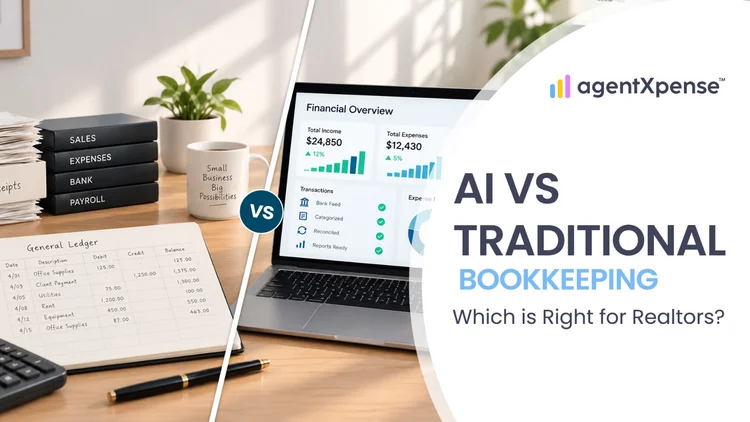
Should Realtors keep their books by hand, hire a bookkeeper or use AI? Compare the options on cost, time and accuracy before you decide.

Stop spending your 11 p.m. evenings sorting faded receipts. Learn exactly what AI bookkeeping can automate for real estate agents, where your human review still matters, and how Agent Xpense saves you hours of manual work.
2255 Dundas Street West, Suite 207 Mississauga, ON L5K 1R6
© Agent Xpense Inc. All rights reserved.