

Real Estate Tips
Catch-Up Bookkeeping for Realtors: How to Fix Months of Missing Expenses
Months behind on bookkeeping? Here's a 5-step process to recover receipts, sort your expenses and get your books current without starting from scratch.
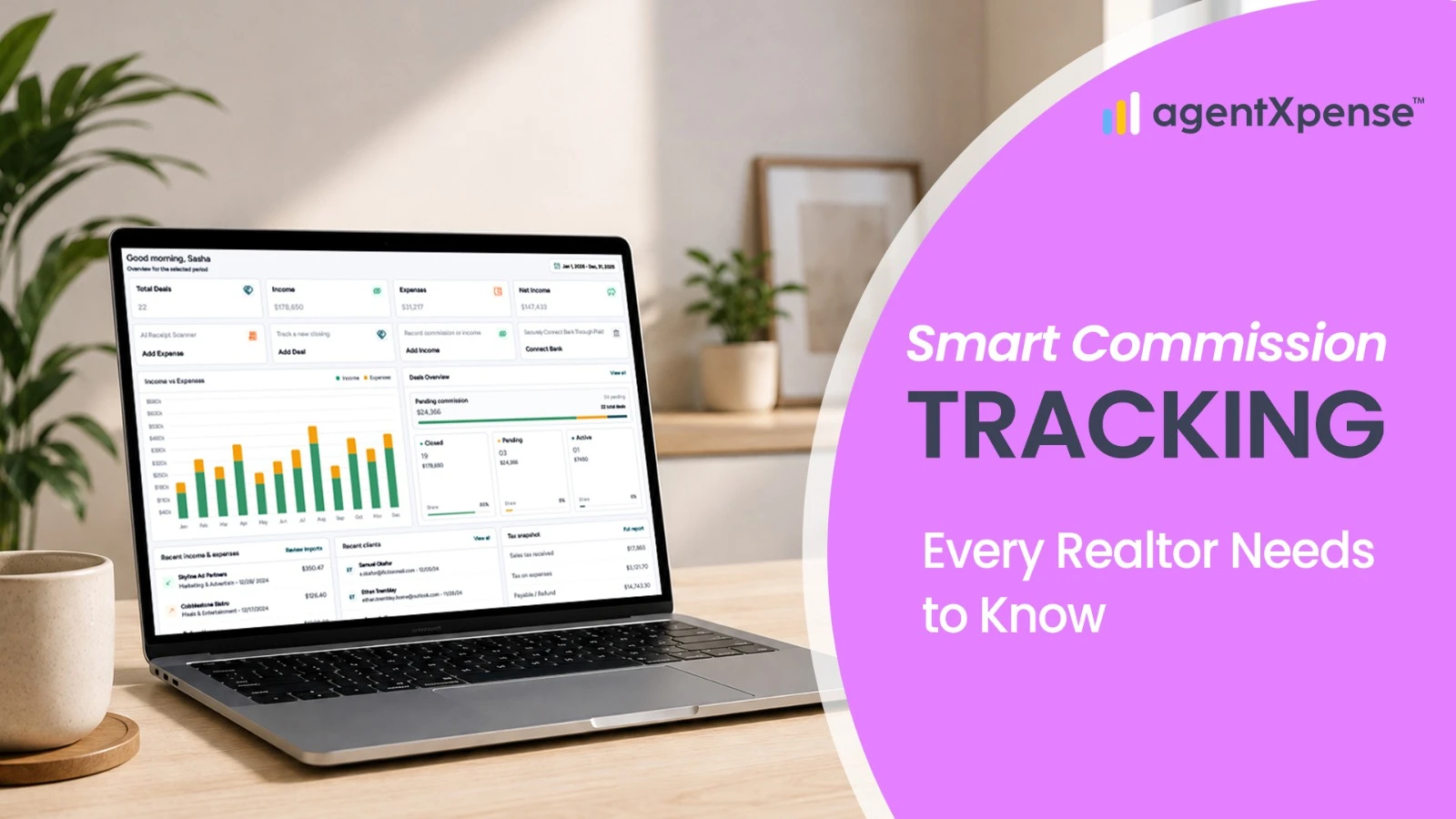
Commission Tracking for Realtors has become an essential part of running a successful real estate business. Every real estate deal represents more than just another closing—it represents your income. Yet many Realtors still rely on spreadsheets, handwritten notes, or memory to track commissions. It works at first, but as deals increase, pending commissions, payment dates, sales tax, and multiple transactions quickly become difficult to manage. That's why many agents eventually switch to real estate commission tracking software that automates commission management and provides complete visibility into every transaction.
Whether you're representing buyers, sellers, or lease clients, every transaction follows a different timeline before your commission reaches your account. Without an organized commission tracker for Realtors, it's easy to lose sight of expected income, overlook pending payments, or spend valuable time managing spreadsheets rather than serving your clients.
Modern commission management software helps Realtors track every commission from the moment a deal is created until payment is received. Agents can track deal progress, review pending commissions, generate commission reports, and monitor their real estate income from one centralized dashboard without manually calculating earnings or searching through emails and paperwork.
In this guide, you'll learn how Realtor commission tracking works, why spreadsheets often create more problems than they solve, and what features to look for when choosing the right real estate commission software for your business.
Realtor commission tracking is the process of recording, monitoring, and managing the income earned from every real estate transaction. Rather than simply knowing how much commission you earned, effective tracking follows each deal from listing or purchase through closing, payment, and final reporting.
A complete commission tracker for Realtors typically records information such as:
Property address
Client details
Deal type (Buyer, Seller, or Lease)
Sale or purchase price
Gross commission
Sales tax
Net pay
Commission status (Pending or Received)
Payment date
Notes related to the transaction
Keeping this information organized gives agents a clear view of both current earnings and future cash flow. Realtors can instantly see which deals are active, which payments are pending, and how much commission income has already been received, eliminating the guesswork around outstanding payments.
Unlike salaried professionals, Realtors rarely receive predictable monthly paychecks. Income depends on deals closing successfully, commission payments being processed, and multiple transactions moving through different stages at the same time.
Imagine managing several active listings while also representing buyers and lease clients. Some commissions may be received next week, while others won't arrive for another month. Without proper real estate income tracking, it becomes difficult to answer simple business questions like:
Which commissions are still pending?
How much income should I expect this month?
Which deals have already been paid?
How much have I earned this year?
Which transactions are generating the highest revenue?
As your business grows, these answers become increasingly important—not only for managing cash flow but also for planning expenses, reviewing performance, and preparing accurate financial records.
Many Realtors begin their careers using Excel or Google Sheets because they're familiar and inexpensive. For a handful of transactions each year, spreadsheets may seem sufficient.
The challenge appears as your business grows.
Every new deal requires manual updates. Commission calculations must be entered by hand. Status changes need constant editing. Pending payments are easy to overlook, and one incorrect formula can affect multiple transactions without being noticed.
Over time, spreadsheets often become scattered across different files, making it difficult to track commissions accurately. Over time, spreadsheets create extra administrative work and increase the risk of costly mistakes rather than giving Realtors a clear view of their finances.
That's why many agents eventually replace spreadsheets with dedicated commission management software that automatically organizes deals, calculates earnings, and tracks every commission from pending to received.
Many Realtors begin with Excel or Google Sheets because they're familiar, free, and easy to set up. At first, a spreadsheet feels like enough. You enter the property address, commission amount, and expected closing date, then calculate your earnings manually.
But as your business grows, so does the complexity.
A few active transactions quickly become dozens. Some deals close on time, while others are delayed or fall through. Buyers, sellers, and lease transactions all have different timelines. Before long, you're updating multiple spreadsheets, checking formulas, and trying to remember whether a commission has been received or is still pending.
This is exactly where manual commission tracking starts costing you time.
Rather than improving visibility into your business, spreadsheets become another administrative task that requires constant maintenance.
Common challenges Realtors face include:
Forgetting to update pending deals after closing
Losing track of commission payment dates
Manually calculating sales tax on every commission
Searching through multiple spreadsheets to find old transactions
Creating reports before tax season
Estimating future cash flow based on pending commissions
The larger your business becomes, the harder these tasks become to manage manually.
For Realtors, commission tracking should cover more than the amount received after a closing. Each transaction can include the property address, buyer or seller details, listing or purchase date, deal status, commission amount, applicable sales tax, net pay, payment status, and the date the commission was received. Keeping these details together gives agents a clear financial record of each real estate transaction and makes it easier to review where a deal stands without checking separate spreadsheets, payment records, or client files.
A good real estate commission tracker should also leave room for client information and transaction notes. This is especially useful when an agent is managing several active deals at different stages. With the right commission tracking software for real estate agents, an agent can quickly identify commissions that are active, pending, or already received, while keeping the related financial and deal information organized in one place.
Many Realtors only record commission income after the payment arrives, which limits their visibility into future cash flow.
That doesn't give you a complete picture of your business.
Pending commissions are future income. Even though the payment hasn't reached your bank account yet, it helps you forecast upcoming cash flow and plan your finances more accurately.
Imagine you have:
three pending buyer transactions
two pending lease commissions
one seller transaction expected to close next month
Without proper pending commission tracking, it's difficult to know how much income is expected over the next few weeks.
When every deal is recorded from the moment it becomes active, you always know:
expected commission income
upcoming payment dates
pending revenue
projected cash flow
That visibility helps Realtors make smarter financial decisions throughout the year.
A real estate deal can cost you money before it ever pays you. Listing photos, online ads, staging, brochures, signs, lockboxes, client gifts, and other expenses can all add up during a transaction.
For that reason, recording the commission alone does not tell you much about what the deal actually contributed to your business. If a property brings in $56,069 in commission and you spend $1,016 on marketing, looking at both numbers together gives you a much clearer idea of the deal's profitability.
AgentXpense lets Realtors keep commission and expense information organized around their deals. You can see the commission amount, expenses, and net figures in the same place instead of checking separate spreadsheets or records. Over time, this also makes it easier to see which types of marketing and transaction expenses are worth continuing and which ones are eating into your earnings.
One of the biggest advantages of dedicated commission management for real estate agents is having all your earnings visible in one dashboard.
Rather than opening multiple spreadsheets or searching through old emails, you can instantly view:
Active deals
Pending commissions
Received payments
Total commission earned
Sales tax collected
Net pay
Deal history
This gives Realtors an accurate snapshot of their business whenever they need it.
Whether you're preparing for a meeting with your accountant or simply checking your monthly performance, every commission is already organized and easy to find.
When you're closing only a handful of deals each year, a spreadsheet might feel like enough.
You create a few columns for the property address, client name, commission amount, and payment date. Everything looks organized.
Until business starts growing.
Suddenly you're managing multiple buyers, sellers, lease transactions, pending payments, brokerage splits, taxes, expenses, and dozens of active deals simultaneously. One incorrect formula or accidental deletion can throw off your entire commission report.
This is exactly why many successful agents eventually move away from spreadsheets and start using real estate commission software built specifically for Realtors.
Unlike spreadsheets, dedicated commission management software updates everything automatically. Your deals, commission status, expenses, income, and reports all stay connected in one place, eliminating duplicate work and reducing costly mistakes.
You always know the status of your next commission without searching through spreadsheets or payment records.
A commission tracker can be as simple as a place to record payments, or it can keep the financial details of your real estate business together. For most Realtors, the second option is more useful because commissions are tied to specific deals, clients, expenses, and payment dates.
Real estate commissions do not always arrive at the same time a deal moves forward. A transaction may be active today, pending tomorrow, and paid after closing. A commission tracker for Realtors should make it easy to see where each transaction stands and which commissions are still pending.
With clear statuses such as Active, Pending, and Received, you can check your expected commissions without going through separate spreadsheets or payment records.
Commission information is easier to understand when it stays connected to the deal that generated it. Your real estate commission tracking software should let you keep the property address, client information, deal type, transaction status, related expenses, and notes with the commission record.
This gives you one place to review the financial details of a transaction and makes it easier to understand what you earned from each deal.
Commission reports give you a quick way to keep track of your real estate income without going through individual transactions one by one. You can use them to see how much commission you have earned during a month, check which deals are still pending, review your total income for the year, and see how your revenue is spread across different transaction types. Sales tax information can also be reviewed alongside your other financial records.
Having this information in one place makes it easier to keep your records up to date and see how your business is performing.
Commission income is only part of what a Realtor needs to keep track of. A $25,000 commission may look great on its own, but the picture changes once you account for the money spent on marketing, photography, staging, fuel, client gifts, and other business expenses.
Keeping real estate income tracking and expense management together gives you a better view of what remains after those costs. Instead of looking at commission deposits separately from your expenses, you can review both sides of your business finances and get a clearer idea of your actual earnings.
Even experienced Realtors can run into bookkeeping problems when commission records are not updated regularly. A few simple habits can make commission tracking much easier to manage.
Waiting until a transaction closes before adding it to your records can leave you with little idea of what income is coming up. Recording a deal once it is under contract gives you a better view of pending business and expected commissions.
A commission that has not been paid yet is still useful information for planning. Keeping pending commissions in your records helps you estimate upcoming income and plan business expenses without relying only on money that has already reached your account.
Keeping deals in one spreadsheet, commissions somewhere else, expenses in separate software, and notes in another place makes bookkeeping harder than it needs to be. A centralized real estate commission tracking and expense management system can keep these records together, making it easier to find the information you need.
Gross commission is not the only figure that matters. Depending on where you operate, sales tax and other tax-related information may also need to be recorded with your financial activity. Keeping this information updated as you go can make your reports more useful and give you cleaner records when it is time to prepare your taxes.
Unlike generic accounting software, AgentXpense was built around the way Realtors actually work.
AgentXpense combines deal tracking, commission management, expense tracking, AI receipt scanning, and reporting into one platform, eliminating the need to manage multiple disconnected applications.
As deals move through your pipeline, your commission information stays connected automatically.
You can quickly view:
Pending commissions
Received commissions
Net pay
Sales tax
Linked expenses
Deal profitability
Client information
Financial reports
Every commission remains connected to the complete transaction, creating a more organized and accurate financial record than standalone spreadsheet entries.
Whether you're an independent Realtor, part of a team, or managing broker commission tracking across multiple agents, everything stays organized in one dashboard designed specifically for real estate professionals.
AgentXpense is built for real estate professionals who want their commission income, expenses, deals, and client records organized in one place. It can be used by independent Realtors, real estate teams, brokerages, and agents handling buyer, seller, or lease transactions. Whether you are keeping track of a few active deals or managing a larger pipeline, AgentXpense gives you one place to record commissions, follow expenses, review financial activity, and keep your bookkeeping organized throughout the year.
Commission income is the lifeblood of every real estate business, but earning commissions is only half the job. Knowing where your income is coming from, what's still pending, how much tax has been collected, and what your actual profit looks like is what separates organized Realtors from overwhelmed ones.
Manual spreadsheets may work in the beginning, but they rarely keep up as your business grows. A dedicated real estate commission tracker gives you better visibility, fewer errors, more accurate reporting, and far less administrative work.
With AgentXpense, commission tracking becomes part of a complete financial management system built specifically for Realtors. From deal tracking and commission tracking to real estate income tracking, AI receipt scanning, and detailed commission reports, everything works together in one place. If you're ready to stop managing commissions in spreadsheets, AgentXpense gives you one place to track deals, monitor pending and received commissions, manage expenses, and stay organized as your real estate business grows.
Most Realtors use spreadsheets, CRMs, or dedicated real estate commission software to record deals, monitor pending commissions, calculate earnings, and generate financial reports.
A commission tracker for Realtors helps agents record every transaction, monitor payment status, organize commission income, and view earnings from pending and completed deals.
Accurate commission tracking improves cash flow forecasting, simplifies bookkeeping, reduces reporting errors, and helps Realtors understand their overall business performance.
Yes. Modern commission management software automates calculations, organizes deals, tracks payments, and generates reports, making it far more efficient than manual spreadsheets.
While a real estate commission calculator estimates earnings for a single transaction, commission tracking software records every deal, monitors payment status, and keeps your complete commission history organized.
Yes. AgentXpense allows Realtors to track both pending and received commissions while connecting every payment to the related deal, expenses, clients, and financial reports.
Months behind on bookkeeping? Here's a 5-step process to recover receipts, sort your expenses and get your books current without starting from scratch.
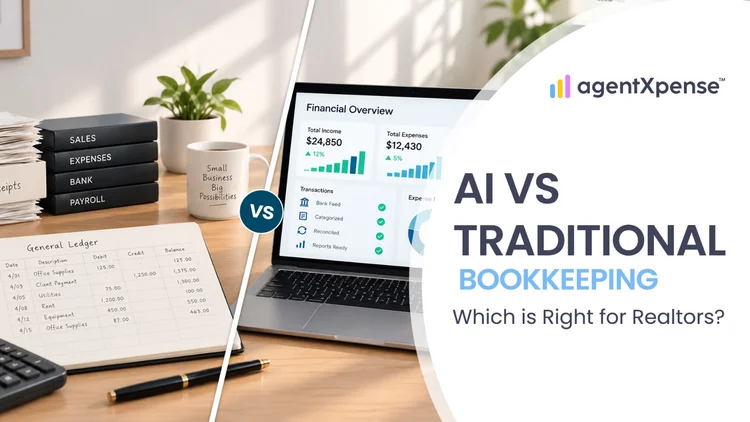
Should Realtors keep their books by hand, hire a bookkeeper or use AI? Compare the options on cost, time and accuracy before you decide.

Stop spending your 11 p.m. evenings sorting faded receipts. Learn exactly what AI bookkeeping can automate for real estate agents, where your human review still matters, and how Agent Xpense saves you hours of manual work.
2255 Dundas Street West, Suite 207 Mississauga, ON L5K 1R6
© Agent Xpense Inc. All rights reserved.