Think earning a massive commission check means you’re taking it all to the bank? Think again. Without tracking your real estate agent tax write-offs, you are essentially writing a blank check to the IRS—and leaving thousands of dollars of your hard-earned profit on the table.
If you are a real estate agent, your income does not look anything like a steady nine-to-five paycheck. One month, you close three deals; the next month, none. This commission-based volatility changes everything when it comes to taxes.
Unlike salaried employees, you do not have an employer automatically withholding taxes from your paychecks. When you are self-employed, you are entirely responsible for income tax, self-employment tax, tracking expenses, and planning quarterly payments.
Many agents focus solely on production and ignore their numbers until tax season. Then, the panic sets in. Failing to claim ordinary and necessary business expenses means you are leaving free money on the table and paying taxes on income you did not actually keep. Real estate agents in the United States and Canada can generally deduct reasonable, ordinary, and directly related business expenses, provided proper documentation is maintained.
Story Time: How One Agent Overpaid Thousands
Let’s look at a simple example to show how easily unorganized record-keeping destroys your profit margin.
Sarah is a full-time real estate agent who earned $185,000 in gross commissions. On paper, that looks like an incredible year. However, because she did not properly organize her expenses throughout the year, she only claimed $22,000 in deductions when she first filed.
After working with a CPA to reconstruct her records, her legitimate real estate agent tax deductions write-offs totaled closer to $63,000.
Sarah’s Financial Breakdown
Expense Category | Unorganized Tracking | Professional Bookkeeping Recovery |
Gross Commissions | $185,000 | $185,000 |
Marketing, Branding & Tech | $22,000 | $44,500 |
Vehicle & Transportation | $0 | $6,500 |
Home Office Expenses | $0 | $2,400 |
Professional Fees & Brokerage | $0 | $9,600 |
Total Taxable Income | $163,000 | $122,000 |
The Takeaway: Proper tracking of real estate agent tax write-offs reduced Sarah's taxable income by an additional $41,000. Depending on her marginal tax bracket, that single mistake cost her well over $10,000 in unnecessary taxes.
Tax Overview: How Much Do Realtors Pay?
Self-employed real estate agents generally pay two distinct types of taxes: federal/state income tax and self-employment tax.
The self-employment tax rate is 15.3%, which consists of 12.4% for Social Security and 2.9% for Medicare. This tax applies to your net self-employment earnings of $400 or more.
Because no broker is withholding taxes from your commission checks, you must manage your own tax obligations by making quarterly estimated taxes payments to avoid IRS penalties. If you expect to owe $1,000 or more in taxes for the year, you must submit payments four times a year using Form 1040-ES.
1. Marketing & Advertising
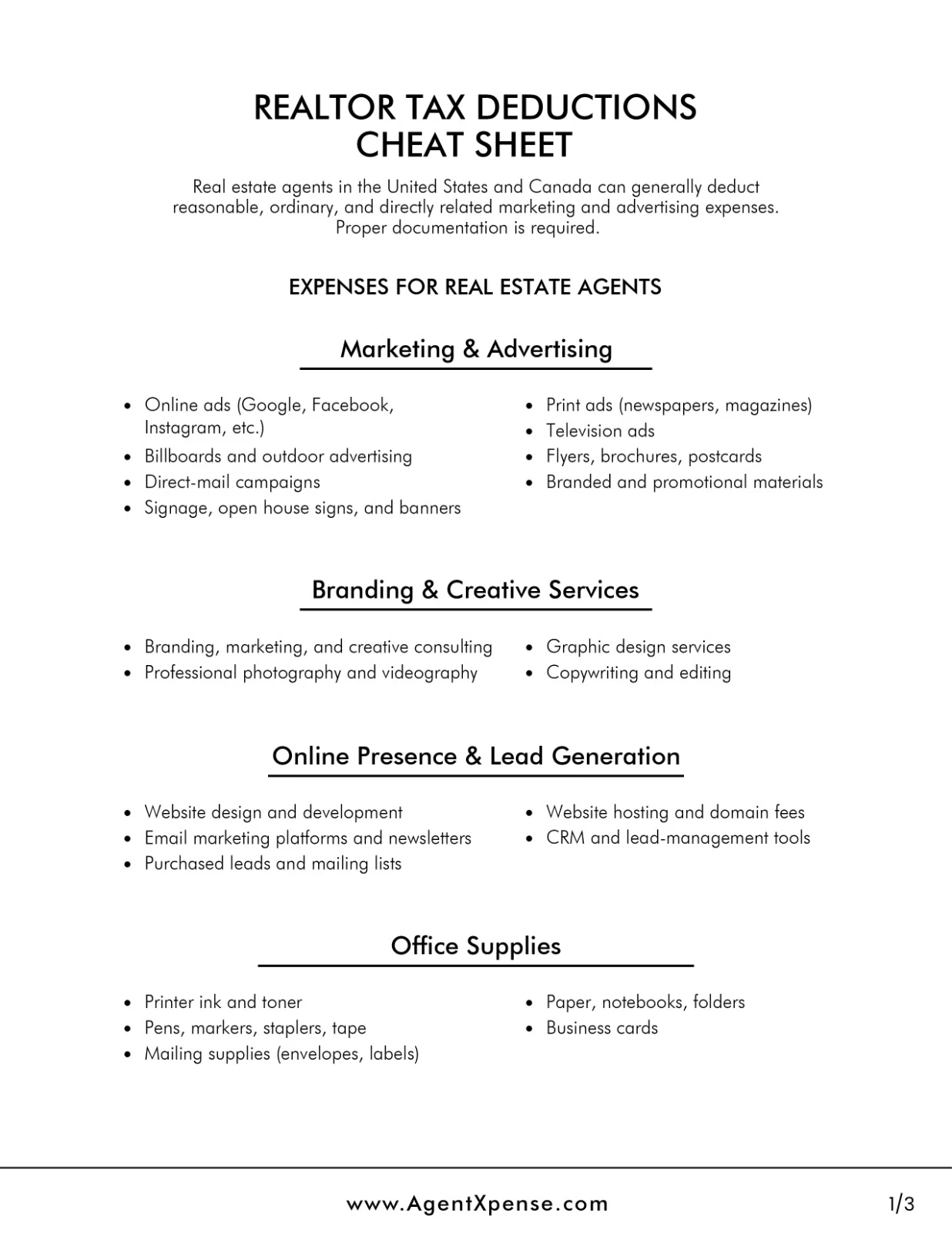
Any money spent on client acquisition costs and lead generation marketing expenses cheat sheet is fully deductible.
Online Ads: Your monthly spend on a Google Ads deduction, Facebook Ads deduction, and Instagram Ads deduction.
Billboards and Outdoor Advertising: Out-of-home advertising placements used to build neighborhood dominance.
Flyers, Brochures, Postcards & Direct-Mail Campaigns: Traditional geographic farming campaigns and community mailers.
Signage, Open House Signs, and Banners: Structural presentation signs used to direct property traffic.
Print Ads: Ad placements inside local newspapers and regional magazines.
Television Ads: Broadcast and commercial airtime marketing investments.
Branded and Promotional Materials: Custom merchandise, luxury leave-behinds, and swag.
2. Branding & Creative Services
Personal branding expenses directly promote your business operations and are fully deductible.
Branding, Marketing, and Creative Consulting: Fees paid to agencies or strategists to develop your identity.
Professional Photography and Videography: Listing photography, video home tours, promotional drone footage, and professional headshot photography.
Graphic Design Services: Logo design, custom listing presentation layouts, and branding assets.
Copywriting and Editing: Content creation fees for property brochures, website copy, and email newsletters.
Home Staging Expenses: Home staging consultations and furniture rentals for vacant properties are fully deductible property presentation costs.
3. Online Presence & Lead Generation
Your digital real estate infrastructure is a major operating cost. Ensure you track the following software and digital assets:
Website Design and Development: Capital spent building modern custom real estate websites.
Website Hosting and Domain Fees: Annual domain registrations and cloud hosting infrastructure fees.
Email Marketing Platforms and Newsletters: Software expenses for automated email lists (e.g., Mailchimp, CRM integrations).
CRM and Lead-Management Tools: Customer Relationship Management subscriptions like LionDesk, KvCORE, or Salesforce.
Purchased Leads and Mailing Lists: Paid customer lead acquisition channels (e.g., Zillow Premier Agent leads or targeted demographic mailing lists).
4. Office Supplies
Day-to-day administrative consumables are easily written off tax deduction cheat sheet 2026. Keep these itemized receipts:
Printer Ink and Toner: High-frequency printing costs for contracts and flyers.
Pens, Markers, Staplers, and Tape: General desk utilities.
Mailing Supplies: Envelopes, shipping labels, and postage expenses.
Paper, Notebooks, and Folders: Presentation folders and day-to-day note pads.
Business Cards: Physical networking cards used during prospecting.
5. Office Equipment & Furniture
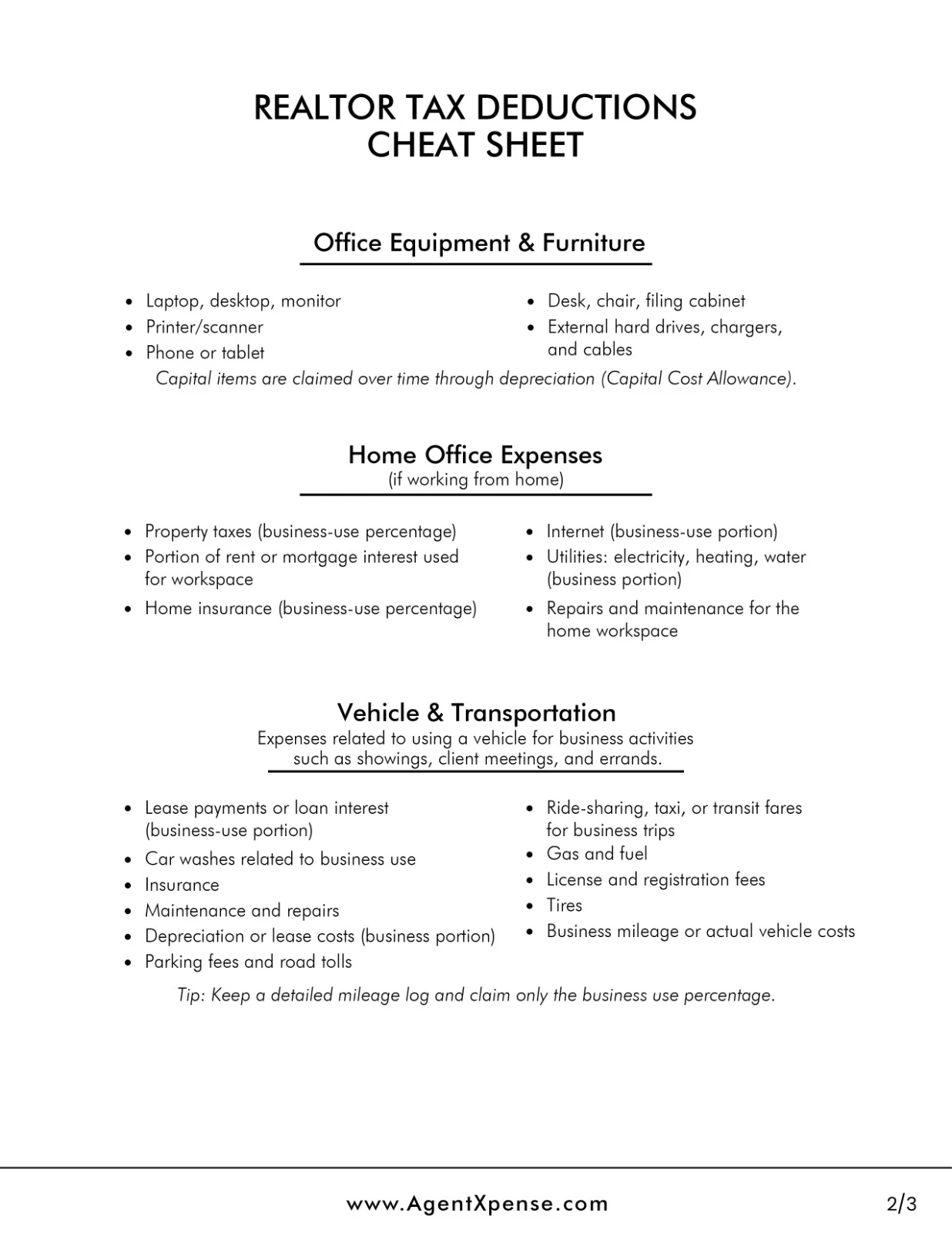
The physical hardware and capital assets required to run your operations efficiently can be written off.
Hardware Essentials: Laptops, desktop computers, and monitors.
Printers and Scanners: Equipment for managing physically signed client paperwork.
Phone or Tablet: Mobile hardware dedicated to communication and on-the-go MLS checks.
Office Furniture: Executive desks, ergonomic office chairs, and file cabinets.
Support Gear: External hard drives, device chargers, and connectivity cables.
Note: Capital items are claimed over time through depreciation (referred to as Capital Cost Allowance in Canada) rather than written off entirely in a single year.
6. Home Office Expenses
If you work from home, your designated workspace must meet strict criteria. The area must pass the exclusive use rule, meaning it is used solely for running your real estate business operations.
You can write off these operating costs based on your specific business-use percentage calculation:
Property Taxes: Pro-rated business portion of your local property tax.
Rent or Mortgage Interest: The portion of rent or home mortgage interest used directly for the workspace.
Home Insurance: Pro-rated business-use percentage of your home policy.
Internet: The dedicated business-use portion of your high-speed web bill.
Utilities: Pro-rated business portion of electricity, heating, and water.
Repairs and Maintenance: Direct fix expenses for the home workspace itself.
7. Vehicle & Transportation
Using a vehicle for business activities such as showings, client meetings, and errands generates massive deductions. You must keep a detailed mileage log and claim only the business use percentage. For the 2026 tax year, the standard mileage rate is 72.5 cents per mile.
If you use the actual expense method, you can track and deduct the following:
Lease Payments or Loan Interest: The specific business-use portion of your vehicle financing.
Car Washes: Cleanliness upkeep related to professional business use.
Insurance, Maintenance, and Repairs: Standard protection policies and mechanical upkeep costs.
Depreciation or Lease Costs: The business portion of the car's structural asset write-off.
Parking Fees and Road Tolls: Work-related parking and travel fees.
Ride-sharing, Taxi, or Transit Fares: Public transport alternatives for business trips.
Gas and Fuel, License and Registration Fees, and Tires: Direct operational inputs.
8. Meals & Entertainment
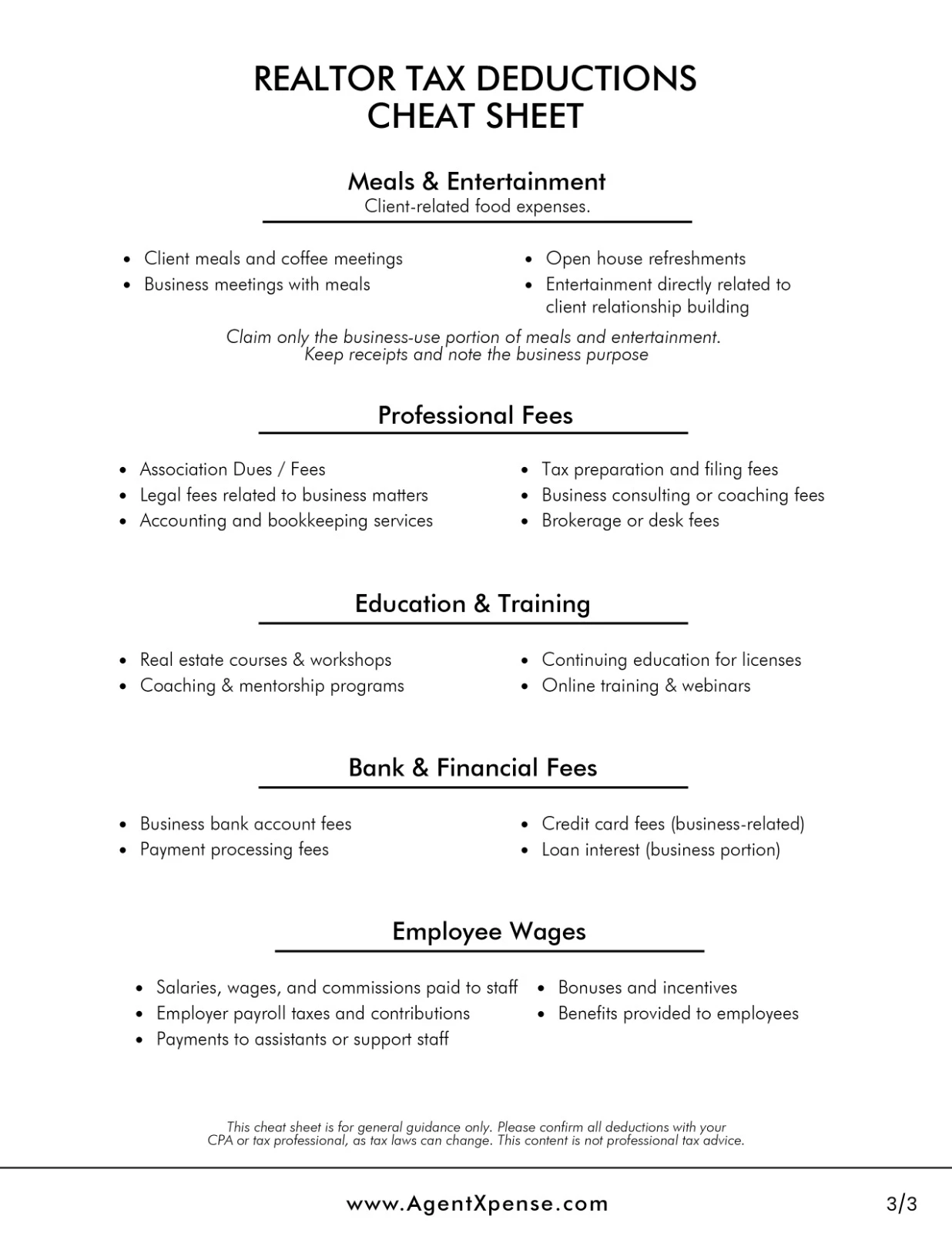
This covers client-related food expenses. Remember, you must claim only the business-use portion, keep the receipts, and note the specific business purpose. Standard client dining remains 50% deductible in 2026.
Client Meals and Coffee Meetings: Dining with prospects to discuss listings or market updates.
Business Meetings with Meals: Team alignment or strategic networking lunches.
Open House Refreshments: Food, snacks, and catering provided directly to the public (this specific category is 100% deductible).
Entertainment Directly Related to Client Relationship Building: Note that strict IRS limitations apply to ticketing costs, but independent food costs at venues are allowable.
9. Professional Fees
These mandatory legal and brokerage expenses directly reduce your taxable commission base.
Association Dues / Fees: Local, state, and National Association of Realtors (NAR) annual dues.
Legal Fees: Legal counsel costs related directly to business matters.
Accounting and Bookkeeping Services: Back-office expenses for professional financial tracking.
Tax Preparation and Filing Fees: Professional CPA costs for tax return filing.
Business Consulting or Coaching Fees: Subscriptions to real estate coaches or industry mentorship systems.
Brokerage or Desk Fees: Monthly desk rentals, commission splits, and franchise operational fees.
10. Education & Training
Professional educational items are fully deductible, provided they improve your skills within your current real estate career.
Real Estate Courses & Workshops: Training courses, seminars, and strategy workshops.
Coaching & Mentorship Programs: One-on-one professional accountability systems.
Continuing Education for Licenses: Mandatory state/board certification renewals.
Online Training & Webinars: Digital industry modules and online training libraries.
11. Bank & Financial Fees
Keep track of the hidden costs of processing money within your business:
Business Bank Account Fees: Monthly service charges on your dedicated business checking account.
Payment Processing Fees: Transaction fees charged when handling credit card settlements.
Credit Card Fees (Business-Related): Annual card fees or interest accrued on your business credit line.
Loan Interest (Business Portion): Interest paid on equipment loans or working capital lines of credit.
12. Employee Wages
If you run a real estate team or hire individual operational support staff, these payroll expenses are fully deductible:
Salaries, Wages, and Commissions Paid to Staff: Fixed base pay or performance-based commission splits.
Employer Payroll Taxes and Contributions: Mandatory statutory contributions made on behalf of employees.
Payments to Assistants or Support Staff: Freelance transaction coordinators or administrative contractors.
Bonuses, Incentives, and Benefits: Supplemental performance bonuses and health benefits packages provided to employees.
13. What Real Estate Agents Cannot Deduct
Understanding what cannot be claimed is just as important as knowing what can. Claiming improper realtor tax deductions cheat sheet 2026 increases your audit risk:
Personal Clothing: Everyday clothing, suits, or designer wear are not deductible, even if you buy them exclusively to look professional at open houses.
Commuting Costs: Driving from your home to your regular, primary brokerage office location is personal commuting and is never deductible.
Personal Upkeep: Grooming, haircuts, makeup, and gym memberships do not qualify as business expenses, even if you are the "face" of your brand.
Fines and Penalties: Parking tickets, speeding tickets received while rushing to a showing, or late renewal penalties from your local real estate board cannot be written off.
14. Real Estate Agent Expense Checklist - Summary Table
Expense Category | Deductibility Rate | Key Documentation Needed |
Business Mileage | 72.5¢ per mile (2026) | Time, date, destination, business purpose log |
Digital/Print Marketing | 100% | Receipts, ad platform invoices, tear sheets |
Brokerage & MLS Fees | 100% | Settlement statements, association invoices |
Client Gifts | Max $25 per person | Recipient name, date, business purpose |
Business Meals | 50% | Itemized receipt, attendee names, topic discussed |
Open House Snacks | 100% | Receipts showing event context |
Home Office | Simplified or Actual % | Square footage measurements, utility bills |
15. Realtor Bookkeeping & Audit Protection Tips
An automated financial record management system is your best defense against an IRS or CRA audit. Avoid the classic mistake of mixing personal and business transactions.
Audit-Proof Bookkeeping Best Practices
Separate Accounts: Maintain a dedicated business bank account setup and an exclusive business credit card tracking routine. Never pay for personal groceries with your business commission account.
Receipt Management: Digitize your proof of purchase immediately. Thermal paper receipts fade over time; snap a photo and attach it to your digital records.
Automate with AgentXpense: Instead of managing messy spreadsheets or losing physical receipts, use AgentXpense to seamlessly log your real estate transactions, automate your mileage tracking, and categorize every single write-off according to industry standards. It is built specifically to keep your business audit-proof.
Tax Record Retention: The IRS can audit returns for up to three years under normal circumstances (and up to six years for substantial understatements). Maintain your tax record retention for a minimum of seven years.
Incorporate When Ready: Speak to a certified professional about a tax-efficient business structure. Transitioning via an S corp election for realtors or setting up an LLC can significantly lower your self-employment tax burden once your net commissions reach a certain threshold.
Every missed deduction is money out of your pocket. Download your free Real Estate Agent Tax Deduction Cheat Sheet and start tracking the write-offs that can save you thousands each year.