You just closed a deal, and the commission finally hit your bank account. Then comes the practical question: how much should a Realtor set aside for taxes?
There is no single tax percentage that applies to every Realtor. The amount you should set aside depends on your income, deductible business expenses, business structure, and where you live. Your tax obligations can also differ depending on whether you are in the US or Canada.
Rather than relying on a generic rule of thumb, it helps to build a tax reserve based on how your business actually works. In this guide, we'll look at what affects your tax bill, how commission income can make budgeting difficult, and how tracking your income and expenses throughout the year can help you stay prepared.
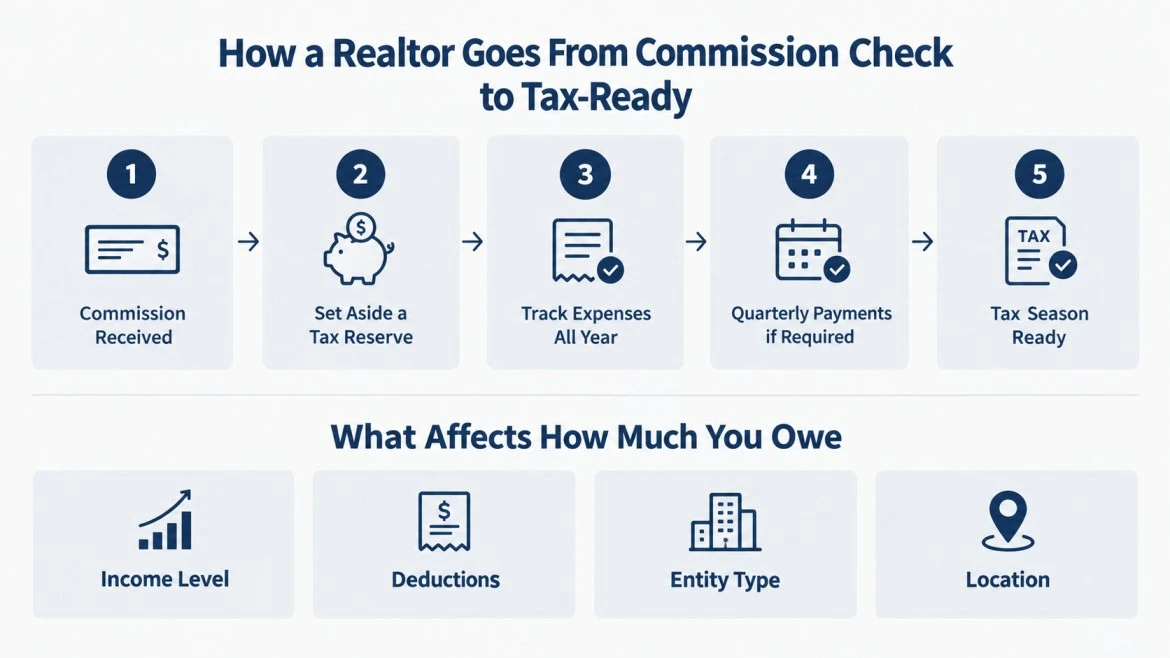
Key Takeaways
There is no single percentage that works for every Realtor. The amount you should set aside depends on your income, eligible business expenses, business structure, filing status, and location.
Commission income can be unpredictable. Setting money aside throughout the year can make it easier to prepare for tax payments when they are due.
Tracking business expenses matters. Eligible business expenses may reduce your taxable income, subject to applicable tax rules and limitations.
US Realtors may need to plan for federal income tax, self-employment tax, and estimated tax payments, depending on their individual circumstances.
Canadian Realtors may need to plan for income tax and, depending on their circumstances, GST/HST obligations.
Building a Realtor tax reserve is easier with a separate savings account. Moving a portion of each commission check into this account can help keep money available for tax payments when they are due.
This guide is for general informational purposes only. Tax rules vary by jurisdiction and individual circumstances, so always confirm your specific tax situation with a qualified tax professional.
Why Tax Planning Is Different for Realtors
Most employees never really think about taxes. Taxes are generally withheld before employees receive their pay. Realtors don't have that built in.
When your commission check lands after closing a deal, taxes have not been withheld from that commission check. That means it's on you to set aside your own share before you spend it.
That's a big part of why tax planning looks different for real estate agents. Understanding self-employed Realtor taxes means thinking a few steps ahead, so you're not caught off guard when your tax bill shows up.
Why Commission Income Makes Budgeting Difficult
Managing commission income taxes can be tricky because commission income doesn't arrive on a fixed schedule. You could close three deals in March and none in April.
That kind of unpredictability creates two real problems.
First, it's tempting to spend the whole check. Without automatic withholding, the tax portion just sits in your regular account looking like it's yours to spend, because on the surface, it is.
Second, it's genuinely hard to know what your annual income will look like early on. A slow first quarter can turn into a strong second half, and your tax bill can end up bigger than you'd planned for.
This is exactly why so many agents look for one fixed percentage to set aside. A flat number feels safer than sitting with the uncertainty. But get that number wrong, and you'll either come up short at filing time or save more than you actually needed to.
What Determines How Much You Should Set Aside?
A handful of factors combine to shape what you'll actually owe. None of them tells the whole story by itself.
Factor | Why It Matters |
|---|
Total annual income | Higher taxable income can result in higher tax at applicable rates |
Business expenses | Eligible business expenses may reduce your taxable income, subject to applicable rules and limitations |
Entity structure | Your business or entity structure can affect how different types of income are taxed |
Location | Federal, state, provincial, and local tax rules and rates can vary |
Filing status | Your filing status can affect applicable tax rates, deductions, credits, and thresholds |
Self-employment tax (US) | Self-employed individuals may owe Social Security and Medicare taxes in addition to federal income tax |
GST/HST obligations (Canada) | Some self-employed Realtors may need to register for, collect, and remit GST/HST depending on their circumstances |
Retirement contributions | Certain retirement contributions may provide tax deductions or other tax benefits, depending on the plan and applicable rules |
Monthly vs Quarterly Tax Planning
When it comes to commission tax planning, Realtors generally use one of two approaches: saving a little throughout the year, or making estimated payments every quarter. Here's how they compare.
Approach | How It Works | Best For |
Monthly Tax Reserve | Move a percentage of every commission check into a separate tax savings account as soon as it arrives | Agents with irregular income who want to keep tax money separate |
Quarterly Estimated/Instalment Payments | Make required estimated tax (US) or instalment (Canada) payments during the year based on applicable rules and your estimated tax liability | Agents who prefer to plan around scheduled payments |
These aren't either-or choices. Many agents do both, saving steadily throughout the year, then using that same money to cover their quarterly payments when they come due.
In the US, self-employed individuals, including Realtors, may need to make estimated tax payments if they expect to owe at least $1,000 in tax after withholding and credits, and their withholding and credits do not meet the applicable IRS requirements. Generally, taxpayers can avoid an underpayment penalty by paying at least 90% of their current-year tax or 100% of their prior-year tax, whichever is less. For certain higher-income taxpayers, the prior-year threshold is 110%. Which rule applies and how much you need to pay depends on your specific tax situation. A tax professional can help determine the appropriate amount.
In Canada, the CRA generally requires quarterly instalment payments if your net tax owing is more than $3,000 (or $1,800 for Quebec residents) in the current tax year and was also more than the applicable threshold in either of the two preceding tax years. Both conditions must be met. GST/HST remittance is a separate matter and depends on your registration status and circumstances.
How Business Expenses Affect Taxable Income
Keeping track of your eligible business expenses can lower what you're taxed on. What you can deduct, and how much, depends on the applicable tax rules.
Common expense categories that may be deductible for Realtors include:
Marketing and advertising (signage, listing photography, online ads)
MLS and association dues
Vehicle expenses (mileage, gas, maintenance tied to business use)
Office rent and supplies
Phone, fax, and internet costs
Meals with clients (subject to specific limits)
Home office deduction, if you qualify
Education, seminars, and licensing renewals
Technology and equipment, including software subscriptions
Legal and professional fees
Let's put some numbers to it. Imagine two Realtors who each earn $90,000 in commission income for the year. The difference in how they track eligible business expenses can have a significant impact on their taxable income and potential real estate agent tax savings.
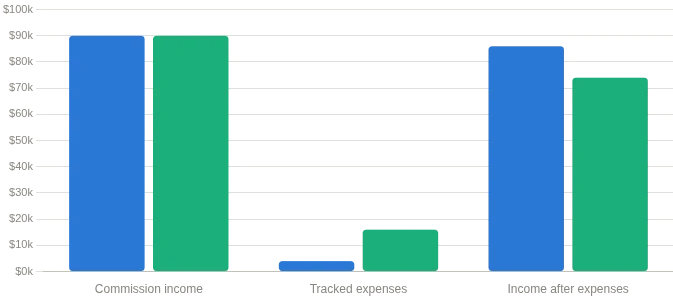
In this simplified example, Agent B tracks significantly more in business expenses than Agent A. Assuming those expenses are deductible under the applicable rules, Agent B ends up with $12,000 less taxable income. The real-world tax impact always depends on the agent's specific situation, but this shows exactly why tracking every receipt matters.
Example of a Realtor With Irregular Commission Income
Picture a Realtor in their third year of independent practice. Their commission checks over one year looked something like this:
January to March: $8,000 total (slow winter market)
April to June: $34,000 (spring buying season)
July to September: $22,000
October to December: $16,000
Their total annual income came to $80,000, with the early months bringing in less than the rest of the year.
Instead of waiting to see what their final total would look like, they moved a percentage of every commission check into a separate tax savings account the moment it landed.
When their accountant later worked out their actual tax liability, their eligible mileage, marketing expenses, and home office deduction all came into play too. The money they'd already set aside covered most of what they owed, with just a small top-up needed at the end.
That's the whole point: setting money aside from each check as it comes helps because your income shifts throughout the year. You don't need to know your exact annual total on day one to build the habit.
How Expense Tracking Helps With Tax Preparation
One of the biggest real estate agent bookkeeping challenges is staying organized. When receipts are scattered across email, glove compartments, and phone photos, two things tend to happen: you may miss deductions you could otherwise have claimed, and you can end up spending hours trying to piece together a year's worth of expenses after the fact.
Automated Expense Capture: Snap a photo of a receipt, and Agent Xpense reads the vendor, date, and amount, then suggests a category like ‘Marketing & Advertising’ or ‘Vehicle Expenses,’ so you only need to review and confirm the details.
Per-Deal Net Income Visibility: Agent Xpense logs your commission and brokerage deductions on a per-deal basis and lets you link related expenses (like staging, photography, and closing gifts) to that same deal, giving you a rough sense of what each transaction netted you.
Bank Connections: With a paid plan, Agent Xpense connects to your bank via Plaid for automatic weekly transaction imports, reducing manual data entry. You review and categorize imported transactions before they enter your records.
Pre-Construction Project Tracking: Realtors who work pre-construction projects can track multi-tranche commission payments across project milestones — all linked to the project and flowing into your reports automatically.
Tax Snapshot: Agent Xpense gives you a quick view of your sales tax activity, helping you keep track of amounts coming in and going out and prepare for applicable sales tax obligations.
Duplicate Detection: The system checks new expenses and imported transactions against your existing records to help avoid logging the same receipt twice.
Smart Categories: Agent Xpense learns your frequent vendors over time, helping it suggest categories more accurately based on how you spend.
Tax Season Prep: Reports can be generated for any date range, and you can download a ZIP file of receipts for the period and export your expense and income data as CSVs to share with your accountant.
None of this replaces a tax professional's judgment. It keeps your records organized and ready, so you and your tax professional spend less time sorting receipts and more time reviewing your numbers.

Questions to Ask Your Tax Professional
Every Realtor's situation looks different, so bring these questions to your accountant or tax advisor rather than relying on generic advice found online.
Based on my actual income and expenses, what percentage should I be setting aside this year?
Does my current entity structure make sense, or would incorporating change my tax position?
Am I required to make quarterly estimated payments, and if so, what are my deadlines?
Which of my expenses qualify for deductions, and am I documenting them correctly?
Do I need to register for and remit GST/HST (Canada) or handle self-employment tax correctly (US)?
Should I be contributing to a retirement account to reduce my taxable income?
Disclaimer: This article is for general informational purposes only and does not constitute tax or accounting advice. Tax rules vary by state, province, and individual circumstances, and change over time. Always consult a qualified tax professional or tax advisor before making decisions about your specific tax situation.
FAQs
How much should a self-employed Realtor save for taxes?
There is no fixed percentage that applies to everyone. Instead of relying on a generic rule, you should calculate your tax reserve based on your projected annual income, business structure, and tracked deductible expenses. Because commission income fluctuates, reviewing your profit margins regularly and working with a tax professional can help you determine the amount you should set aside from each commission check.
Should Realtors pay quarterly taxes?
If you’re self-employed, you may need to pay taxes throughout the year instead of waiting until tax season. In the US, you may need to make estimated tax payments if you expect to owe at least $1,000 after withholding and credits and your withholding and credits are below the applicable IRS thresholds.
In Canada, quarterly tax instalments generally apply when your net tax owing is more than $3,000 ($1,800 for Quebec residents) and you also owed more than that amount in one of the previous two years. If you’re not sure whether you need to make quarterly payments, a tax professional can help you work out what applies to your situation.
Do business expenses reduce taxable income?
Yes, eligible business expenses reduce your taxable income. Deductibility limits vary by expense type and applicable tax rules. Staying organized with your receipts throughout the year helps ensure you don't miss write-offs when it's time to file.
Should Realtors keep a separate tax savings account?
Many agents find it helpful to move a portion of every commission check into a separate tax savings account as soon as it arrives. It keeps tax money separate from everyday spending and reduces the risk of coming up short when payments are due.
Final Thoughts
Tax stress for Realtors usually comes down to one thing: not knowing the answer to "how much should a Realtor set aside for taxes" until it's too late to plan around it. Tracking your income and expenses as the year unfolds rather than reconstructing it all in April is what turns unpredictable commission income into something you can actually budget around.
Track your Realtor income, expenses, receipts, and commissions with Agent Xpense. Start your 30-day free trial no credit card required.