

Real Estate Tips
Catch-Up Bookkeeping for Realtors: How to Fix Months of Missing Expenses
Months behind on bookkeeping? Here's a 5-step process to recover receipts, sort your expenses and get your books current without starting from scratch.

Working as a real estate agent in the U.S. looks glamorous from the outside, but behind the scenes, the financial pressure is real. Commissions fluctuate, expenses never stop, and taxes can quietly take a huge bite out of your income if you’re not careful. That’s exactly why understanding real estate agent tax deductions is one of the most important skills a realtor can develop.
This guide focuses on real estate agent tax deductions in the USA for 2026, explained in plain language. No complicated tax talk — just practical information you can actually use to keep more of your money.
A tax deduction is any business-related expense that reduces your taxable income. As a realtor, you’re not just an agent — you’re running a business. That means many of the costs you pay out of pocket can qualify as realtor expense deductions.
Instead of paying taxes on your full commission income, deductions allow you to subtract eligible expenses first. This is where real estate tax write-offs make a massive difference. Agents who understand deductions properly often pay significantly less tax than those who don’t, even if they earn the same amount.
Most real estate agents are independent contractors. That means you report both income and expenses yourself. Every legitimate deduction lowers your taxable income, which directly reduces how much tax you owe.
The key is documentation. Expenses must be business-related, reasonable, and properly tracked. This is why many agents rely on tax deduction software to record expenses throughout the year instead of trying to remember everything later. This is why learning how to separate personal and business expenses is the very first step to protecting your hard-earned money.
Because ignoring deductions is like giving the government a tip it didn’t ask for. Taxes are one of the largest expenses realtors face, and real estate agent tax deductions in USA are the most effective way to control that cost.
Agents who take deductions seriously have more cash to reinvest in marketing, education, and growth. This mindset is common among the top real estate agents in USA, who treat tax planning as part of their business strategy — not an afterthought.
Driving is unavoidable in real estate. Showings, inspections, listing appointments, closings — it all adds up. Business mileage is often the largest real estate agent tax deductions category for active agents.
If you don’t track mileage properly, you’re almost guaranteed to lose money. Using apps or tax deduction software helps capture every business mile and turn it into a legitimate real estate tax write-off claim.
Many agents work from home, whether it’s writing contracts, making calls, or managing listings. If you have a dedicated workspace used regularly for business, you may qualify for the home office deduction.
This allows you to deduct a portion of rent or mortgage, utilities, and internet as realtor expense deductions. When done correctly, it’s one of the most valuable real estate agent tax deductions in USA, yet many agents skip it out of fear or confusion.
Marketing is the lifeline of a real estate business. Everything from online ads and websites to photography, staging, and signage can be deducted.
These costs are considered necessary to generate income, which makes them strong real estate tax write offs. Agents who spend aggressively on marketing but forget to deduct it are leaving serious money on the table.
Real estate isn’t cheap to stay in. MLS dues, brokerage fees, license renewals, and continuing education are all required to operate legally.
The good news is that these unavoidable costs qualify as realtor expense deductions. Over the course of a year, these expenses form a reliable portion of real estate agent tax deductions.
Modern real estate runs on technology. CRM systems, transaction platforms, email tools, cloud storage, and design software are no longer optional.
All of these subscriptions qualify as real estate tax write offs. All of these subscriptions qualify as real estate tax write offs. If you're not sure which tool fits your budget, check out our review of the top 5 accounting software for real estate agents to find the perfect match. Agents who use proper tax deductions software often discover they’re spending more on tech than they realized — and deducting less than they should.
Printers, paper, ink, desks, chairs, laptops, and phones may seem like small expenses individually, but together they add up.
These everyday purchases are valid realtor expense deductions when used for business. Over time, they contribute meaningfully to your total real estate agent tax deductions in USA.
Real estate is a relationship-driven business. Meals with clients, referral partners, or prospects can qualify as partial deductions when business is discussed.
This is one of the most commonly misunderstood real estate tax write-offs. Keeping receipts and noting the business purpose makes this deduction much safer and easier to justify.
Traveling for conferences, training, or business meetings can be deducted when the primary purpose is work-related.
Flights, hotels, transportation, and some meals all fall under real estate agent tax deductions. For growth-focused agents, travel deductions can become a meaningful tax saver.
Self-employed agents often pay their own health insurance, and those premiums can usually be deducted. Retirement contributions may also reduce taxable income.
These deductions don’t just save taxes — they protect your long-term financial health. This is a common strategy among top real estate agents in USA who think beyond just this year’s commissions.
Business checking fees, transaction charges, and insurance, like errors and omissions coverage, are necessary operating costs.
They may not feel exciting, but they qualify as realtor expense deductions and help round out your total real estate agent tax deductions.
Manually tracking expenses is risky and stressful. Good tax deductions software automates mileage tracking, categorizes spending, and stores receipts safely.
Agents who use software consistently claim more deductions and face fewer problems at tax time — simple as that. For instance, if you are operating in California, using specialized expense tracking software for California real estate agents can save you from local tax headaches.
Understanding real estate agent tax deductions in USA is not about gaming the system — it’s about running your business intelligently. Every dollar you deduct legally is a dollar you keep.
If you want to operate like the top real estate agents in USA, start treating deductions as a core business skill, not an annual headache.
Q: How does a realtor claim deductions?
File them on Schedule C. Keep records of expenses and use tax deductions software for easier tracking.
Q: Why should real estate agents track deductions?
Tracking ensures you save money legally and don’t miss valuable realtor expense deductions.
Q: Can I deduct mileage and vehicle costs?
Yes! Showings, inspections, and client meetings count. Choose the standard mileage rate or actual expenses.
Q: What counts as marketing deductions?
Website, flyers, social ads, photography, and signage are all valid real estate tax write offs.
Q: Are meals with clients deductible?
Yes, 50% is deductible if the discussion is business-related. Always keep receipts and notes.
Q: Can I deduct a home office?
Yes, if used regularly and exclusively for work. Utilities and a portion of rent or mortgage qualify.
Q: Should I use software to manage deductions?
Absolutely. Tax deductions software helps log expenses, track mileage, and claim every eligible real estate agent tax deduction in USA.
Months behind on bookkeeping? Here's a 5-step process to recover receipts, sort your expenses and get your books current without starting from scratch.
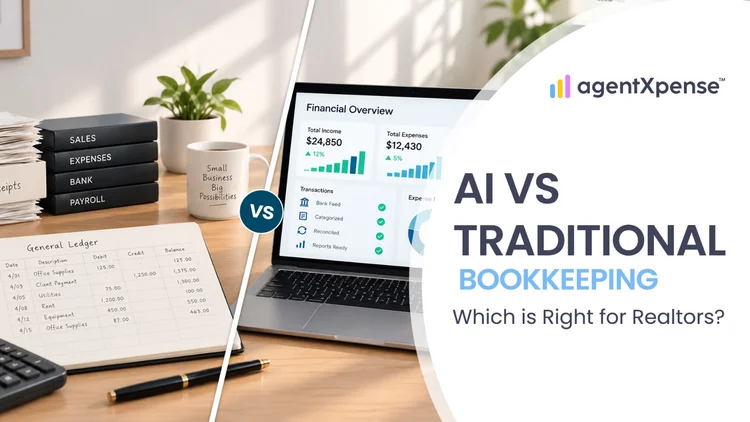
Should Realtors keep their books by hand, hire a bookkeeper or use AI? Compare the options on cost, time and accuracy before you decide.
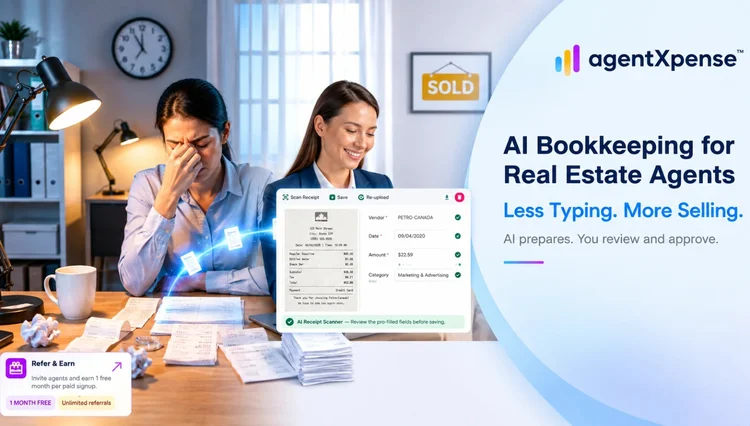
Stop spending your 11 p.m. evenings sorting faded receipts. Learn exactly what AI bookkeeping can automate for real estate agents, where your human review still matters, and how Agent Xpense saves you hours of manual work.
2255 Dundas Street West, Suite 207 Mississauga, ON L5K 1R6
© Agent Xpense Inc. All rights reserved.