

Real Estate Tips
Catch-Up Bookkeeping for Realtors: How to Fix Months of Missing Expenses
Months behind on bookkeeping? Here's a 5-step process to recover receipts, sort your expenses and get your books current without starting from scratch.

For real estate agents in California, tracking expenses isn’t just about organisation — it’s about keeping more of what you earn. Commission-based income, ongoing business costs, and California’s tax rules make it easy to lose sight of your numbers. The right expense tracking software helps agents stay clear on commissions, expenses, and taxes without the constant stress.
So how do California real estate agents keep everything under control?
It often comes down to the tools they use.
Most real estate agents don’t struggle because they’re bad with money. They struggle because the system they’re using was never designed for how real estate actually works — especially in California.
Income comes in waves. Expenses are constant. Marketing costs, MLS fees, gas, client meals, staging, photography, subscriptions, and office expenses all stack up long before a commission ever hits your account. That is why having a clear 2026 realtor tax deductions cheat sheet is crucial to know exactly which of these upfront costs you can legally write off. Add California’s tax structure into the mix, and suddenly it’s very easy to lose track of what you’ve spent, what you’ve earned, and what you actually get to keep.
This is exactly why expense tracking software for real estate agents has become essential, not optional. Relying on memory, scattered receipts, or spreadsheets usually works for a while — until it doesn’t.
Many agents start with generic accounting software because it’s familiar. Tools like spreadsheets or general small-business platforms seem “good enough” at first. Over time, cracks begin to show.
Traditional accounting software treats income as regular and predictable. Real estate income isn’t. Commissions are irregular, broker splits vary, referral fees complicate transactions, and one large closing can hide months of expenses underneath it. Without real estate-specific context, numbers can look better — or worse — than they really are.
This is where real estate expense management software makes a meaningful difference. Instead of forcing agents to adapt their workflow, realtor-focused tools are designed around commissions, deals, and property-related expenses from the start.
The best accounting software for real estate agents doesn’t try to impress with endless features. It focuses on clarity.
At its core, strong real estate bookkeeping tools help agents track commissions and expenses together, not separately. When income and expenses live in different systems, it’s almost impossible to understand profitability on a per-deal basis. Realtor-focused software brings everything into one place so agents can see how much each transaction truly earns after costs.
Another key difference is how expenses are handled. Instead of generic categories, good real estate accounting software understands the types of expenses agents actually incur — marketing, mileage, staging, client entertainment, subscriptions, licensing, and office costs. This makes year-end reporting and tax preparation far simpler.
One of the biggest gaps in general accounting software is commission tracking. Real estate agents don’t just earn income — they earn income tied to specific transactions.
Software built to manage real estate agent commissions and expenses allows agents to associate income with individual deals, track broker splits accurately, and understand cash flow over time. This becomes especially important in California, where high transaction values can mask underlying expense problems.
Knowing how much money is coming in is helpful. Knowing how much you’re keeping is essential.
Real estate isn’t a desk job. Agents are constantly moving — showings, meetings, open houses, closings. That’s why cloud-based accounting for realtors has become the standard.
With cloud-based expense management tools for California realtors, expenses can be logged in real time. Receipts don’t get lost. Mileage doesn’t need to be reconstructed months later. Reports stay up to date automatically.
Whether you’re using an expense tracking app in Los Angeles real estate or managing deals across the Bay Area, cloud-based access ensures your books reflect reality, not guesses.
Not all tools serve agents equally. Here’s a high-level look at how common options compare for California real estate professionals:
Software | Best Fit | Real Estate Focus | Commission Tracking | California Use |
Agent Xpense | Real estate agents & small teams | Yes | Yes | Strong |
QuickBooks | General small businesses | No | Manual | Moderate |
Wave | Budget-focused users | No | No | Limited |
FreshBooks | Freelancers | No | Basic | Limited |
This is why many California real estate agents choose software built specifically for their day-to-day reality, rather than adapting tools made for general businesses. If you want a detailed breakdown of how these platforms stack up head-to-head, you can read our full comparison of the top 5 accounting software for real estate agents currently available.
For teams and small agencies, financial complexity increases quickly. Shared expenses, multiple agents, commission splits, and growth all introduce risk if systems aren’t solid.
Affordable real estate accounting software for small agencies in California helps teams maintain clean records without hiring full-time bookkeeping help. The goal isn’t complexity — it’s consistency: clear numbers, reliable reports, and less time spent fixing mistakes. As your small business grows, you might also want to evaluate should you incorporate as a realtor to see if forming an S-Corp can offer you better liability protection and legal structure.
Tax season is where disorganisation shows up loudest.
Real estate tax tracking software helps agents prepare throughout the year instead of scrambling in April. By keeping expenses categorised and income accurate, agents can estimate taxes more confidently and hand clean reports to their CPA.
This is especially important in California, where underestimating taxes can lead to unpleasant surprises. While no software replaces professional tax advice, having accurate records changes the entire experience.
Los Angeles agents often deal with high mileage, heavy marketing spend, and high transaction volume. San Francisco agents tend to manage fewer deals with larger commission values and complex referral structures.
Despite the differences, both markets benefit from the same thing: clarity. Strong San Francisco real estate accounting tools and Los Angeles-focused expense tracking apps solve the same underlying problem — understanding where money is coming from and where it’s going. In fact, if you want to know the exact habits of Southern California professionals, check out our deep dive on how do real estate agents track expenses in Los Angeles to optimize your local strategy and see what works best in high-volume environments.
The best expense tracking software for California real estate agents doesn’t feel like software at all. It feels like relief.
When commissions, expenses, and reports are organised automatically, agents spend less time worrying about money and more time focusing on clients and deals. In a fast-moving, high-cost market like California, that clarity isn’t just helpful — it’s necessary.
Tools like Agent Xpense are built around how real estate agents actually earn, spend, and report money — which is why they feel simpler to use.
Do I really need expense tracking software as a California real estate agent?
If you’re earning commissions and paying business expenses all year, yes. It’s very easy to lose track otherwise.
I already use spreadsheets. Isn’t that enough?
Spreadsheets work until they don’t. One missed receipt or broken formula, and your numbers stop making sense.
What kind of expenses should I be tracking?
Most agents track marketing, mileage, client meals, staging, photography, MLS fees, subscriptions, licensing, and office costs. To ensure you don't overlook anything that could save you money at tax time, make sure to review our detailed guide on the top 10 tax deductions realtors miss every year.
Can accounting software handle commission-based income?
Some can. Real estate accounting software is designed to track commissions, splits, and referral fees more clearly than general tools.
Is this useful even if my income is inconsistent?
Especially then. Irregular commissions are exactly why having clear expense and cash flow tracking matters.
Can I track expenses while I’m out showing properties?
Yes. Cloud-based accounting for realtors lets you log expenses and upload receipts from your phone.
What about property or listing-related expenses?
Good real estate expense management software lets you tie staging, prep, and listing costs to specific deals.
Will this help with taxes in California?
It helps you stay organised all year, which makes tax time easier. It doesn’t replace a CPA. Not tax advice.
Is accounting software only for teams or big agencies?
No. Solo agents and small real estate businesses often benefit the most because they don’t have time to clean up messy books later.
Months behind on bookkeeping? Here's a 5-step process to recover receipts, sort your expenses and get your books current without starting from scratch.
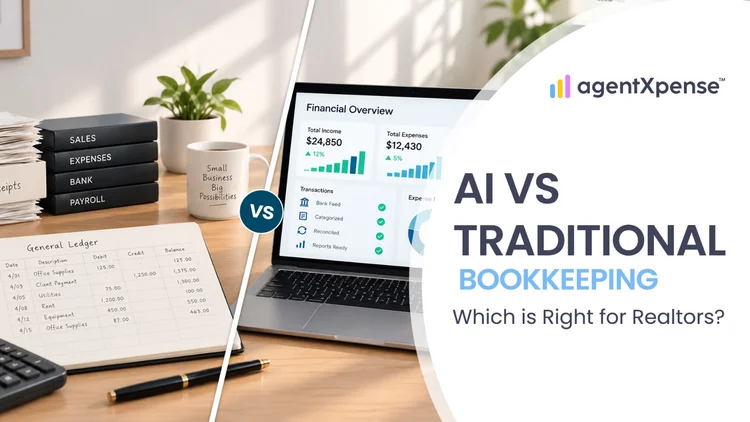
Should Realtors keep their books by hand, hire a bookkeeper or use AI? Compare the options on cost, time and accuracy before you decide.
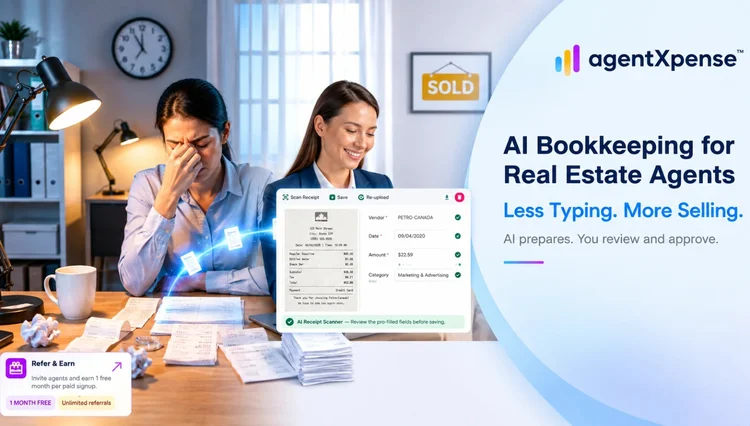
Stop spending your 11 p.m. evenings sorting faded receipts. Learn exactly what AI bookkeeping can automate for real estate agents, where your human review still matters, and how Agent Xpense saves you hours of manual work.
2255 Dundas Street West, Suite 207 Mississauga, ON L5K 1R6
© Agent Xpense Inc. All rights reserved.