

Real Estate Tips
Catch-Up Bookkeeping for Realtors: How to Fix Months of Missing Expenses
Months behind on bookkeeping? Here's a 5-step process to recover receipts, sort your expenses and get your books current without starting from scratch.
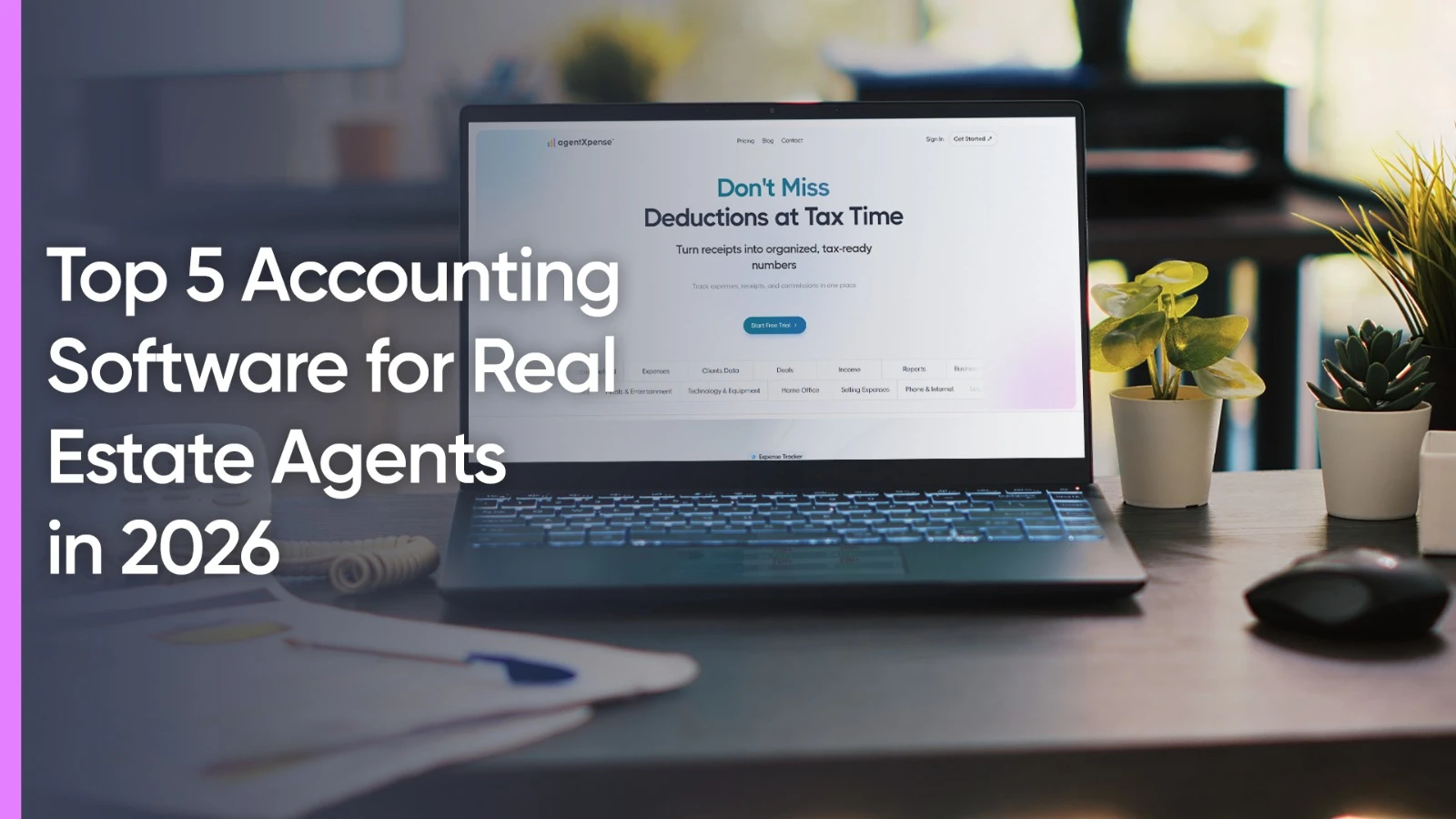
Real estate agents don’t have “normal” finances. Income is irregular, commissions are split multiple ways, expenses pile up fast, and tax season can be painful if your books aren’t clean. That’s why choosing the right accounting software for real estate agents in 2026 isn’t optional — it’s essential.
Whether you’re a solo realtor, part of a team, or running a small brokerage, modern real estate bookkeeping solutions help you track commissions, manage expenses, stay tax-ready, and actually understand your cash flow. This guide covers the top 5 real estate accounting software options for 2026, including tools that work for agents in both the United States and Canada.
We’ll also break down how to track real estate commissions and splits, which is one of the biggest pain points agents face.
Software | Best For | Commission Tracking | Expense Tracking | Tax Support (US & Canada) |
|---|---|---|---|---|
AgentXpense | Realtors focused on commissions | Built-in | Realtor-specific | Reports ready |
QuickBooks Online | Growing agents & teams | Manual (custom categories) | Advanced | Strong (1099, GST/HST) |
FreshBooks | Invoicing & client billing | Basic | Good | Moderate |
Xero | Teams & integrations | Manual (via apps) | Advanced | Strong with add-ons |
Wave | Beginners & free bookkeeping | Limited | Basic | Limited |
AgentXpense is one of the few tools built specifically for real estate agents. Instead of forcing you to adapt generic accounting software, it focuses on how real estate actually works.
AgentXpense is designed around commission tracking, deal tracking, and real estate expense categories. You enter your transactions, and the system helps you understand your income, costs, and profitability without accounting complexity.
Built-in commission tracking and deal summaries
Realtor-specific expense categories (marketing, car, dues, MLS)
Simple financial dashboards
Tax-ready reports
Affordable pricing
AgentXpense works for agents in both countries. While it doesn’t file taxes for you, it produces clean reports that make tax software or accountants much easier to work with.
Best For: Agents who want simple, purpose-built accounting software for real estate agents without the learning curve of full accounting platforms.
QuickBooks Online continues to be the most widely used real estate accounting software in 2026 — and for good reason. It’s powerful, flexible, and built to handle complex financial situations like commission income, referral fees, and large volumes of expenses.
Why Realtors Use It
QuickBooks allows agents to create custom income and expense categories, which makes it easier to track commissions, brokerage splits, marketing costs, mileage, MLS fees, and office expenses. Bank and credit card feeds automatically pull transactions, saving hours of manual entry.
Income tracking for commissions and referrals
Advanced real estate expense tracking
Tax-ready Profit & Loss and Balance Sheet reports
1099 management for realtors in the US
GST/HST/PST support for Canadian agents
Integrates with CRMs, payroll, and payment tools
QuickBooks has dedicated versions for both countries. US agents can easily prepare 1099s, while Canadian agents can track GST/HST and run tax-compliant reports.
Best For: Agents and teams who want scalable bookkeeping, strong tax support, and industry-standard reporting.
FreshBooks is often overlooked by real estate agents, but it’s a strong option if you do client billing, consulting, staging fees, or referral-based work in addition to commission income.
FreshBooks is simple. The interface is clean, invoices look professional, and expense tracking is straightforward. It’s less complex than QuickBooks, which some agents actually prefer.
Professional invoicing and online payments
Simple expense tracking with receipt capture
Automated late-payment reminders
Client profiles and billing history
Works in both the US and Canada
FreshBooks is not built specifically for commission tracking. You’ll still need to manage splits and referral breakdowns manually.
Best For: Solo agents who want easy bookkeeping for realtors and strong invoicing without a steep learning curve.
Xero has become increasingly popular among real estate professionals who rely on multiple apps. If you use CRMs, payment platforms, or third-party commission tracking software, Xero connects everything cleanly.
Xero’s real-time dashboards and automation features make it easier to understand cash flow — especially when commissions come in large, irregular chunks.
Real-time financial dashboards
Advanced expense tracking
Strong integration ecosystem
Multi-user access for teams and accountants
US and Canada tax compatibility via add-ons
Xero doesn’t natively track commission splits, but it works well when paired with commission tracking software or spreadsheets synced via integrations.
Best For: Teams and agents who want flexibility, automation, and app integrations more than industry-specific features.
Wave remains one of the best free options for agents just getting started. If you’re new to real estate or running a side business, Wave covers the basics without monthly fees.
Wave handles income tracking, expense tracking, and basic reports like Profit & Loss. For agents with low transaction volume, that’s often enough.
Free income and expense tracking
Basic invoicing
Financial reports for tax preparation
Works in the US and Canada
Wave lacks advanced commission tracking, automation, and deep tax tools. As your business grows, most agents eventually outgrow it.
Best For: New agents or part-time realtors who want free real estate bookkeeping solutions.
This is where many agents struggle. A solid system should allow you to:
Record gross commission per deal
Track brokerage splits and referral fees
Separate personal income from business income
View commissions by month, quarter, and year
QuickBooks and Xero handle this through custom categories. AgentXpense handles it natively, which saves time and reduces errors.
In the US:
1099 management for realtors is critical
Quarterly estimated taxes matter
Expense deductions can significantly reduce tax bills
In Canada:
GST/HST tracking is essential
Proper categorisation of expenses matters for CRA compliance
The best tax software for real estate agents starts with clean books — and that’s where accounting software makes the biggest difference.
At the end of the day, the best accounting software is the one you’ll actually use. Some agents are fine with full accounting platforms like QuickBooks or Xero, but for many, that level of complexity just gets in the way. If your income is mostly commissions and your goal is to stay on top of expenses without overthinking it, a tool like AgentXpense simply fits how real estate works.
Less setup, less confusion, and a lot more clarity when it comes time to look at your numbers or prep for taxes.
The right tool won’t just save time — it will help you make better financial decisions, reduce tax stress, and run your real estate business like a business.
What is the best accounting software for real estate?
The best option depends on how you work. Many agents use Agent Xpense or Xero, while others prefer simpler, commission-focused tools built for real estate.
What are the 5 accounting software used by real estate agents?
QuickBooks, FreshBooks, Xero, and AgentXpense are among the most commonly used by real estate agents.
What software do real estate agents use?
Most agents use accounting software for finances and a CRM for leads. Popular combinations include QuickBooks or AgentXpense with a real estate CRM.
Months behind on bookkeeping? Here's a 5-step process to recover receipts, sort your expenses and get your books current without starting from scratch.
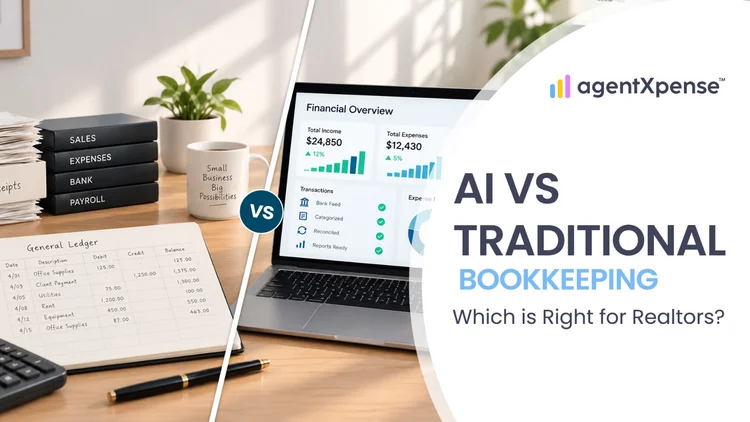
Should Realtors keep their books by hand, hire a bookkeeper or use AI? Compare the options on cost, time and accuracy before you decide.
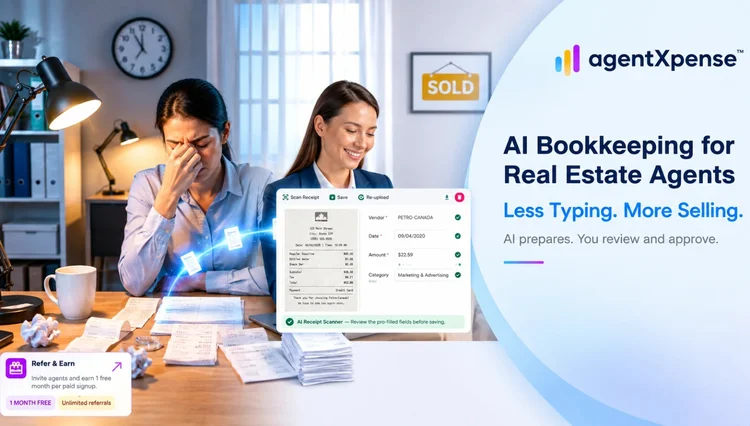
Stop spending your 11 p.m. evenings sorting faded receipts. Learn exactly what AI bookkeeping can automate for real estate agents, where your human review still matters, and how Agent Xpense saves you hours of manual work.
2255 Dundas Street West, Suite 207 Mississauga, ON L5K 1R6
© Agent Xpense Inc. All rights reserved.